
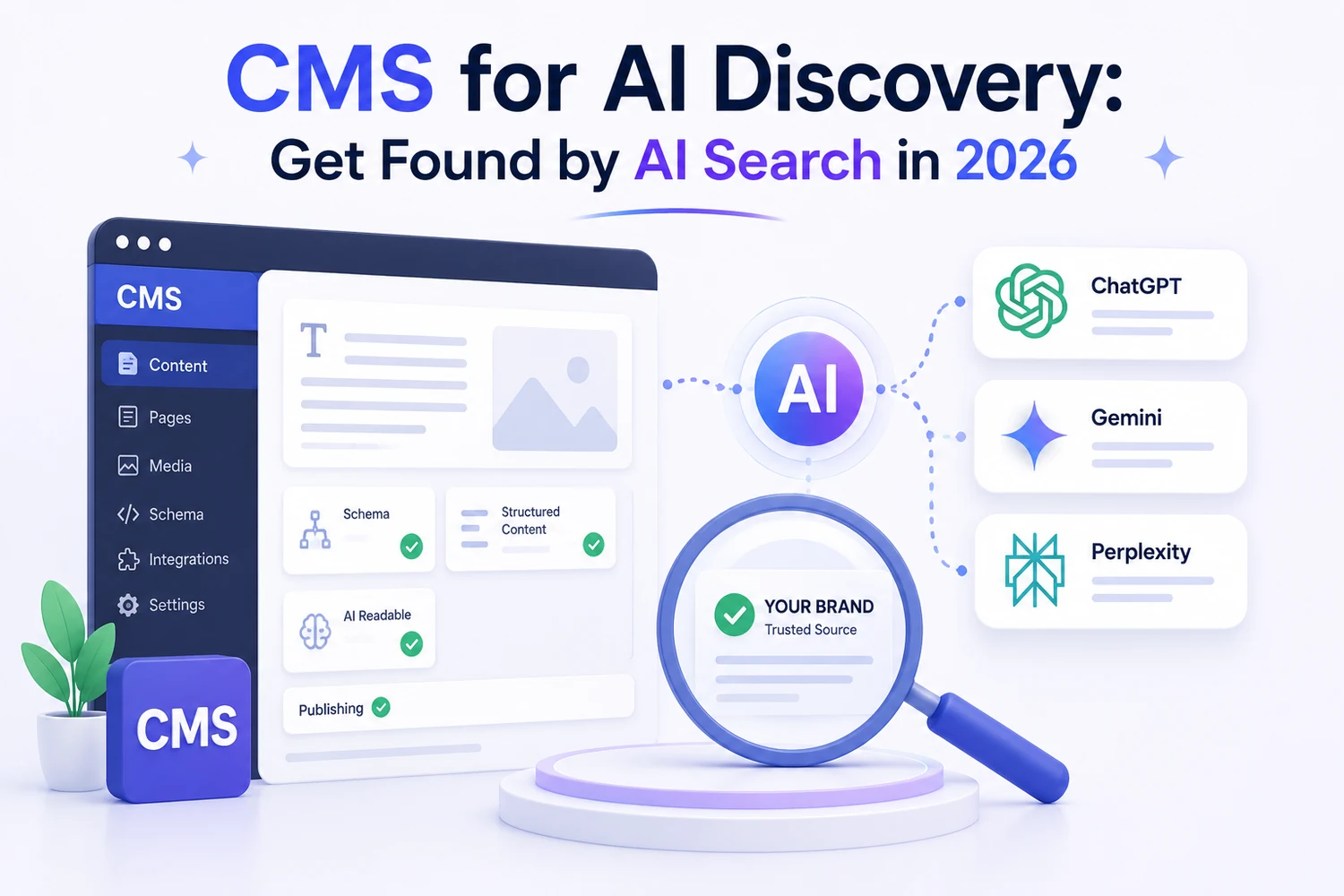
Your CMS has quietly become the most important AI marketing tool you own. In 2026, whether ChatGPT, Gemini or Perplexity can find, understand and recommend your brand depends less on individual pages and more on how your content hub is structured. Here is why the CMS layer now matters for AI discovery and what to fix first.
From Publishing System to Brand Knowledge Hub
For 20 years, CMS software was a publishing tool — a way to get pages onto the web. That framing is now obsolete. AI systems do not read your website page by page; they read your entire domain as a single knowledge graph and evaluate coherence, completeness and internal linking across the whole hub. Fragmented content published by different teams with no consistent taxonomy produces a domain that AI cannot summarise reliably. A well-organised content hub with clear entity relationships produces a domain AI systems can confidently cite. The CMS is where that hub is either built or broken.
Signals AI Systems Look For at the Hub Level
Six signals matter most. First, entity consistency — your brand, products and services referenced by the same name across every page. Second, hub-and-spoke architecture — pillar pages that summarise a topic linking down to detailed spokes and back up. Third, schema depth — Organization, Product, Service, FAQPage and Article schema deployed consistently, not just on the homepage. Fourth, freshness signals — visible update dates, changelogs and content revision histories that show the hub is actively maintained. Fifth, internal linking that mirrors semantic relationships, not just navigation convenience. Sixth, structured metadata for authors, publication dates and canonical URLs that survive AI paraphrasing and citation.
What Most Indian CMS Implementations Get Wrong
Three common failures block AI discoverability. First, inconsistent taxonomy — categories and tags evolved organically over years, producing a mess AI cannot navigate. Second, schema applied only to product pages or blog posts, leaving service pages, comparison pages and location pages invisible to structured retrieval. Third, no internal search or filter layer that surfaces relationships between content, so AI systems miss connections your team assumes are obvious. Fixing these three issues alone typically produces a step-change in AI citation rates within 60–90 days.
How to Audit Your CMS for AI Readiness
Run a five-point audit. Check whether every commercial page has appropriate schema — Product, Service or LocalBusiness as relevant. Check whether pillar pages exist for each of your top five service categories, with a clean hub-and-spoke linking structure. Check that author, date and canonical metadata is populated consistently. Check that internal search on your own site returns useful results — if it does not, AI systems parsing the same content will struggle too. Check that duplicate content, obsolete URLs and orphan pages have been cleaned up so the hub is coherent rather than a museum of every asset ever published.
Building a CMS That Serves AI Discovery
The best-performing content hubs in 2026 share a common architecture. A homepage that clearly summarises the brand and links to major service and product hubs. Pillar pages for each core capability, cited internally by supporting articles. Service pages with structured data, testimonials, FAQ blocks and consistent internal linking. A blog that reinforces the hub structure rather than sitting adjacent to it. And an editorial process that treats every publication as an addition to the knowledge graph rather than a standalone asset. Combining this architecture with sustained content marketing and structured website development produces a domain AI systems consistently choose to cite.
Working With DigiVeritaz
DigiVeritaz audits, restructures and rebuilds content hubs for Indian brands preparing for the shift to AI-first discovery. Our approach combines CMS architecture, schema implementation, pillar content strategy and internal linking cleanup to make your domain the source AI systems prefer to cite in your category. Book a free CMS audit to see where your hub is losing AI visibility and what a 90-day restructure would produce.
Frequently Asked Questions
What does CMS mean in this context?
CMS stands for Content Management System — the software that runs your website. Common examples include WordPress, Webflow, Drupal and headless CMS platforms. In 2026, the CMS is a central factor in how well AI systems discover your brand.
Does my CMS platform choice affect AI discoverability?
The platform matters less than the implementation. A well-structured WordPress site with proper schema outperforms a poorly configured headless CMS. The taxonomy, internal linking and metadata layer are what AI systems evaluate, not the underlying software.
How long does a CMS audit take?
A thorough audit of a mid-sized website typically takes two to three weeks and produces a prioritised remediation plan. Implementation of the highest-impact fixes usually requires four to eight weeks of focused work after that.
Is schema markup really that important?
Yes. In audits of Indian mid-market brands, sites with comprehensive schema implementation show three to five times higher rates of AI answer citation than sites relying on unstructured content, making schema one of the highest-leverage investments available.
Explore our generative engine optimisation services or contact us.