
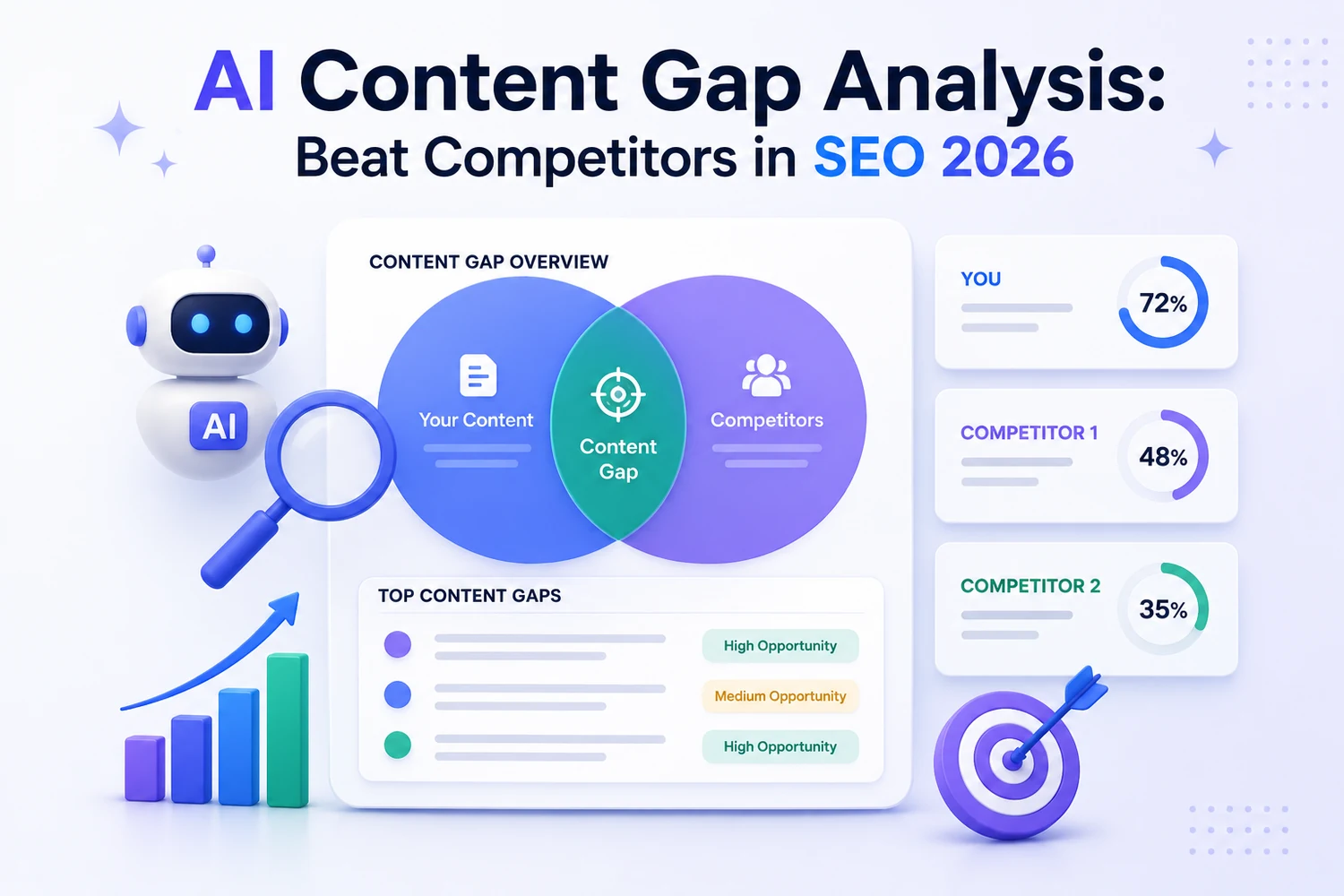
The old content gap analysis — export rival keywords, filter for high volume, publish — has stopped working. In 2026, the real gaps sit at the intersection of what your rivals rank for, what searchers actually behave like on your site and what AI systems get asked but cannot answer well. Here is how to run a modern AI-powered content gap analysis that produces topics with a genuine chance of ranking.
Why Traditional Gap Analysis Falls Short
The classic gap analysis workflow — pull competitor keywords, subtract the ones you already rank for, prioritise by volume — produces long lists of topics your rivals published two years ago. By the time you write them, they are saturated. Volume-first prioritisation also ignores intent: a 20,000-search-volume keyword with informational intent will not drive conversions for a service business no matter how well you rank. Modern gap analysis has to layer competitor data with your own search performance signals, actual user behaviour and the questions AI systems now handle for your category. This is where AI-powered analysis makes the difference.
The Three Data Sources That Matter
First, competitor rankings — the raw list of what rivals rank for and where. Second, your Google Search Console data — the queries you already appear for but do not rank in the top 10, and the pages that get impressions but no clicks. Third, AI answer data — the questions AI assistants answer for your category, and whether they cite anyone at all. When you overlay these three sources, the true gaps emerge as topics where searchers exist, competitors are weak and AI has no clean source to cite.
Running the Analysis: A Five-Step Method
Step one, export the top 200 ranking keywords for your three closest rivals using any commercial SEO tool. Step two, cross-reference against your Search Console data to identify topics where you have partial visibility already — these are the fastest wins. Step three, run each candidate topic through ChatGPT, Gemini and Perplexity and record whether the AI answers with confidence, cites sources or admits uncertainty. Uncertain AI answers signal weak existing coverage — high-opportunity gaps. Step four, cluster the surviving topics by search intent and buyer stage, using your funnel to prioritise. Step five, sequence publication so foundation content ships before the pieces that depend on internal linking to it.
What Makes a High-Value Gap in 2026
A worthwhile content gap in 2026 meets four tests. It has demonstrated search demand — not just competitor rankings, but real query volume in Search Console or third-party tools. It has weak existing coverage — either from AI systems that cannot answer confidently or from thin, outdated pages that rank only because nothing better exists. It aligns with your service capability so a ranking translates to leads or revenue. And it is defensible — meaning original data, expert perspective or unique execution that a rival cannot easily replicate. Topics that only meet the first two tests are traffic bait; topics that meet all four are compounding assets.
How AI Speeds Up the Whole Process
AI turns weeks of manual analysis into hours. Feed competitor keyword exports into an AI tool and prompt it to cluster them by intent and buyer stage. Ask it to identify missing sub-topics based on the pages a rival ranks with. Have it draft outline structures for the top 20 opportunities. This is not a substitute for editorial judgement — the topics still need human review for strategic fit and factual accuracy — but it eliminates the mechanical work that used to consume most of the timeline. A well-designed workflow combining AI acceleration with human editorial oversight can produce a defensible 90-day content roadmap in a single week.
Working With DigiVeritaz
DigiVeritaz runs AI-powered content gap analysis for Indian brands as part of every SEO engagement and content marketing roadmap. Our approach combines competitor intelligence, Search Console mining and AI answer auditing to produce a prioritised topic list that compounds into search visibility and qualified traffic. Book a free gap analysis to see the 10 highest-opportunity topics your brand should own next quarter.
Frequently Asked Questions
What is AI-powered content gap analysis?
It is the practice of using AI tools to identify topics your competitors rank for that you do not cover, filtered by your existing search visibility and by whether AI systems can answer confidently in your category. It compresses weeks of manual analysis into hours.
What tools do I need to run this analysis?
A commercial SEO tool for competitor keyword data, Google Search Console for your own performance signals, and access to ChatGPT, Gemini or Perplexity for AI answer audits. AI can accelerate clustering and prioritisation of the resulting topic list.
How many topics should I prioritise per quarter?
For a mid-market Indian brand publishing one to two pieces per week, a 12- to 15-topic quarterly roadmap is realistic. Attempting more usually reduces execution quality below what is needed to rank.
Can this analysis work for local service businesses?
Yes. Local businesses often see the largest gaps because their competitors under-invest in content. A focused analysis on local queries and service-specific questions typically surfaces 30 to 50 high-opportunity topics.
Explore our SEO services or contact us.