
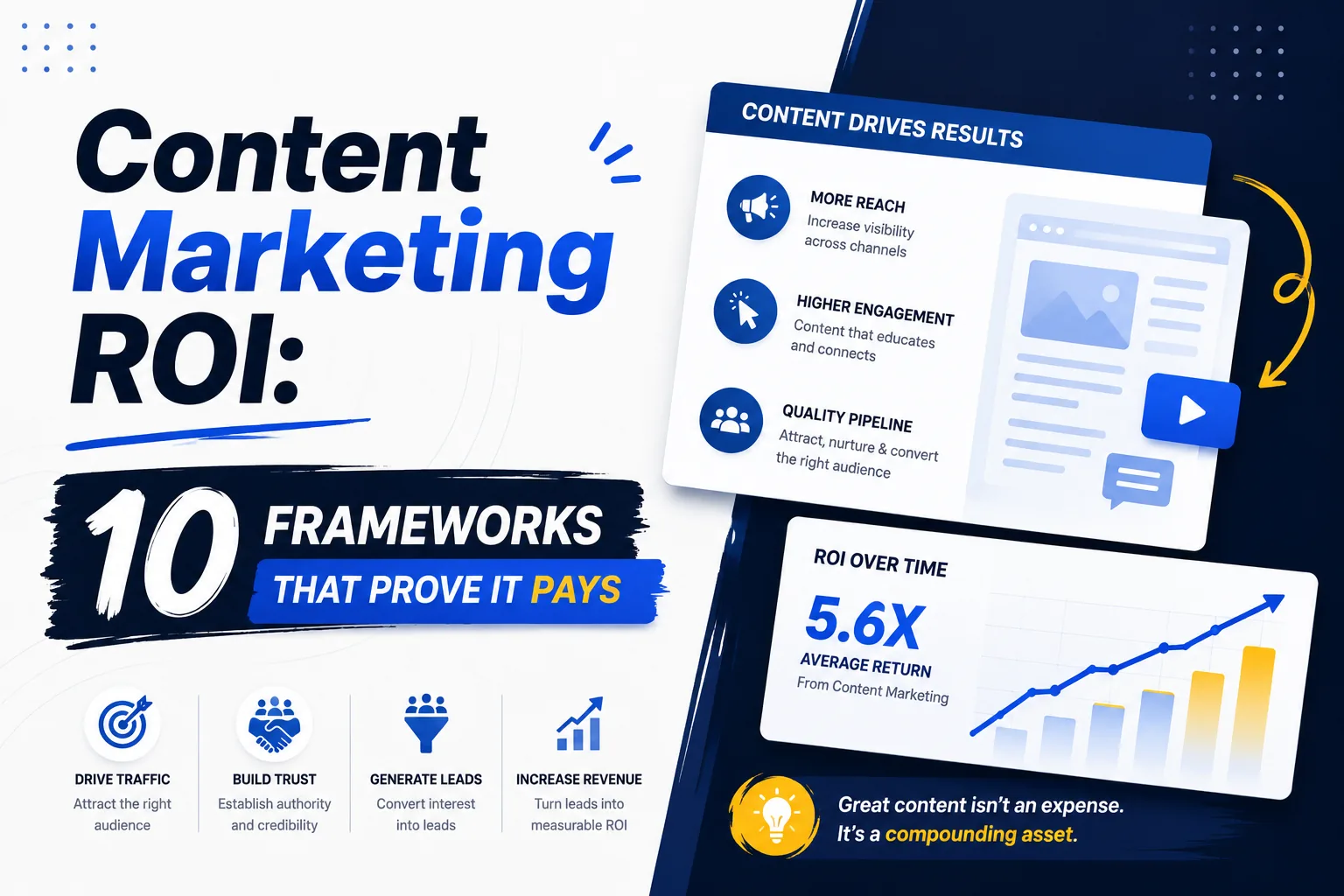
"Content marketing is great, but can you prove it's working?" Every marketing team has faced this question from leadership. And most struggle to answer it convincingly because they're tracking the wrong metrics.
Pageviews don't pay salaries. Social shares don't close deals. The only content marketing ROI that matters is the one measured in revenue attribution, pipeline contribution, and customer acquisition cost reduction.
Here are 10 frameworks for measuring, proving, and maximizing content marketing ROI — so your next budget request comes with data, not faith.
📝 DigiVeritaz builds content strategies that generate measurable ROI through its Organic Marketing Services. Get a free content audit.
1. First-Touch Attribution: Which Content Brought Them In?
First-touch attribution credits the first piece of content a customer interacted with before entering your funnel. Set up UTM parameters on every content piece. Track in GA4 which blog post, video, or social post was the first touchpoint for leads that eventually converted. This tells you which content is best at attracting new audiences.
2. Last-Touch Attribution: Which Content Closed the Deal?
Last-touch attribution credits the last content interaction before conversion. This shows which content is most effective at pushing prospects over the decision line. Often, case studies, comparison pages, and pricing content dominate last-touch attribution. Both first-touch and last-touch models have limitations when used alone, but together they reveal the full picture.
3. Revenue-Per-Blog-Post Calculation
Total revenue from blog-attributed leads ÷ number of blog posts published = revenue per blog post. If you published 20 blogs and they collectively generated ₹15L in attributed revenue, each blog averaged ₹75,000 in revenue contribution. Compare this to your per-post production cost (typically ₹5,000–₹20,000) for a clear ROI calculation. This metric is especially valuable when evaluating investments in Content & Copywriting Services.
4. Content-Assisted Conversions in GA4
GA4's attribution reports show which content pages appeared in conversion paths — even if they weren't the first or last touch. A blog post might introduce a visitor, who leaves, returns via a retargeting ad, reads a case study, and then converts. Content-assisted conversions reveal this full journey and credit every content piece that played a role.
5. Organic Traffic Value: What Would This Traffic Cost in Ads?
Calculate the estimated CPC value of your organic traffic. If your blog generates 50,000 organic visits per month for keywords with an average CPC of ₹25, your content's equivalent paid traffic value is ₹12,50,000/month. Over 12 months, that's ₹1.5 crore in traffic value from content that cost a fraction of that to produce. This framework resonates powerfully with finance teams.
6. Lead Magnet Conversion Tracking
Track how many leads each content-led lead magnet generates. If your "2026 D2C Marketing Benchmarks" PDF generates 200 downloads/month and 15% convert to sales conversations, that's 30 qualified leads per month from a single piece of content. Calculate: lead magnet production cost vs. lifetime value of converted leads. High-performing lead magnets are often created through strategic Content & Copywriting Services.
7. Customer Acquisition Cost (CAC) Comparison: Content vs. Paid
Compare the CAC of content-sourced customers vs. paid-advertising-sourced customers. Typically, content-sourced customers have 30–50% lower CAC because the content pre-educates and pre-qualifies them before they enter the sales process. They require fewer sales touches, have shorter sales cycles, and negotiate less on price.
8. Content Influence on Sales Cycle Length
Track whether prospects who consume content before their first sales call close faster. In most B2B companies, content-educated prospects close 20–40% faster because the content has already addressed their objections, built trust, and demonstrated expertise. Calculate the revenue impact of shorter sales cycles.
9. SEO Compound Growth Model
Content marketing ROI compounds over time. A blog post published today generates organic traffic for 2–3+ years. Model the cumulative traffic, leads, and revenue from your content library over 12, 24, and 36 months. This compound growth model shows why content is an investment, not an expense, and justifies sustained budget allocation. Businesses leveraging professional Organic Marketing Services often see stronger long-term compounding effects.
10. Competitive Share-of-Voice Analysis
Track your brand's organic visibility vs. competitors for your target keyword universe. If you rank for 200 keywords while competitors rank for 500, your content share-of-voice is 40%. Set quarterly targets to increase this share. Correlate share-of-voice gains with pipeline growth to demonstrate content's competitive impact and strengthen your overall SEO Services strategy.
Frequently Asked Questions
How long does content marketing take to show ROI?
Most content marketing programs show measurable ROI within 6–9 months. Initial organic traffic gains appear within 3–4 months. Lead generation from content typically stabilizes by month 6. The compounding effect means ROI accelerates over time, especially when supported by consistent Organic Marketing Services.
Is content marketing worth it for small businesses?
Yes. Content marketing's CAC is 62% lower than outbound marketing on average. For small businesses with limited ad budgets, content generates leads at near-zero marginal cost once published. Start with 2–4 blog posts per month targeting long-tail keywords and invest in quality Content & Copywriting Services where possible.
What are the best content marketing KPIs?
Revenue attribution (first-touch and last-touch), organic traffic value, lead magnet conversion rate, content-assisted conversions, and customer acquisition cost comparison (content vs. paid channels).
How do I prove content marketing value to leadership?
Use the organic traffic value framework ("Our content generates ₹12.5L/month in equivalent ad value") combined with revenue attribution ("Content-sourced leads generated ₹X in pipeline this quarter"). Lead with financial impact, not vanity metrics. Strong reporting frameworks are a core component of successful Organic Marketing Services.
How much should I spend on content marketing?
Most successful content programs allocate 25–40% of the total marketing budget to content. For Indian SMBs, this typically means ₹50,000–₹2,00,000/month covering strategy, creation, distribution, and optimization, including SEO Services and Content & Copywriting Services.