
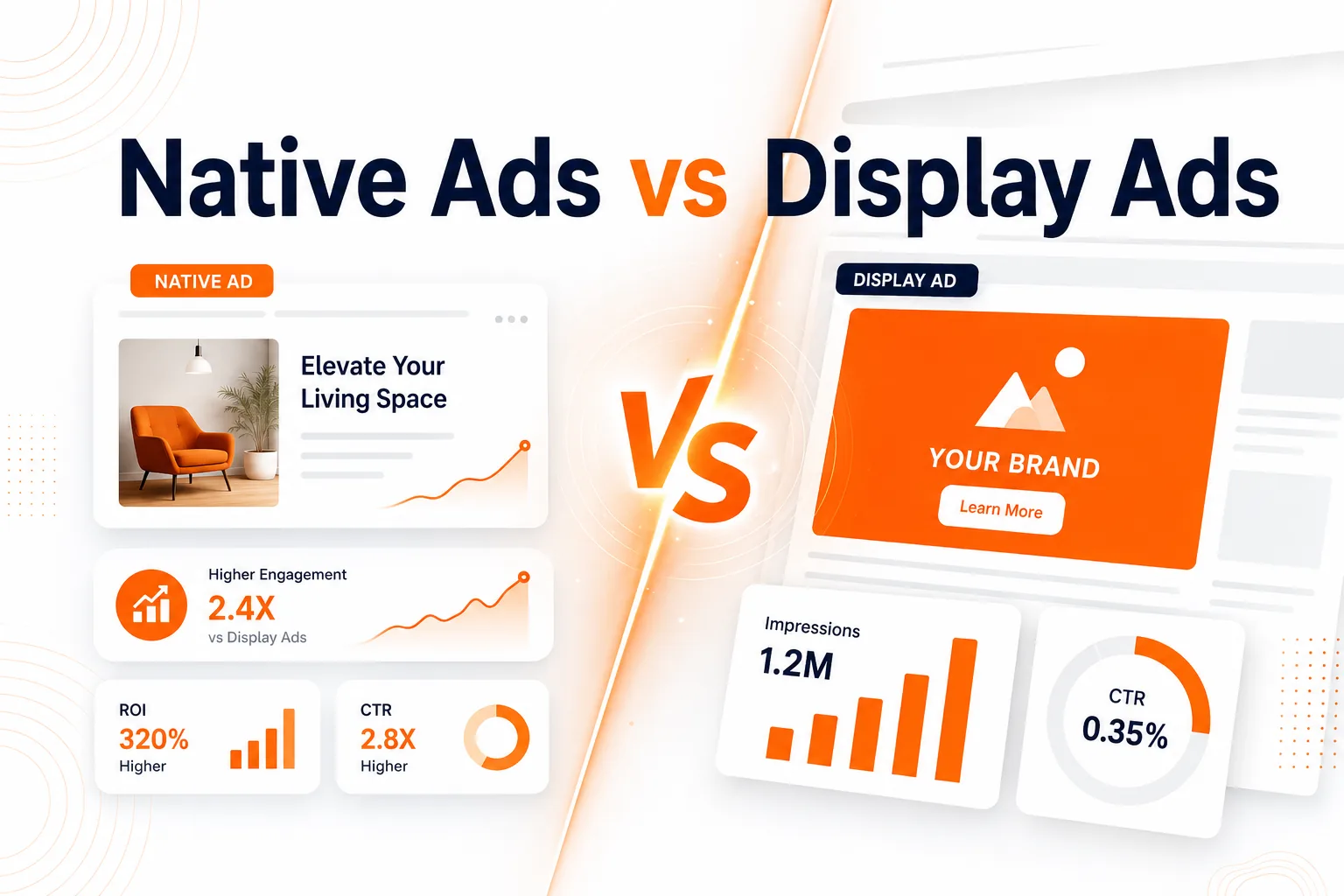
Two brands. Same budget. One runs native ads — articles and in-feed content that blend seamlessly into editorial environments. The other runs display ads — banners and rectangles that interrupt the reading experience. In 2026, the ROI difference between these two approaches is not marginal. It is significant.
This guide breaks down exactly how native advertising and display ads work, where each delivers the best returns, and which format your brand should be investing in.
What Is Native Advertising?
Native advertising is paid content that matches the form, function, and feel of the editorial environment in which it appears. A native ad in a news publication looks like an article. A native ad in a social media feed looks like an organic post. A native recommendation widget at the bottom of an article looks like related content.
The defining characteristic of native advertising is that it does not feel like an ad — until the reader notices the "Sponsored" or "Promoted" label. This seamlessness is the source of both its effectiveness and the ethical debate that surrounds it.
- Native ads are viewed 53% more frequently than display ads
- Native ad click-through rates are 8.8x higher than display banner CTRs
- Consumers interact with native content 20 to 60% more than display
- Native advertising drives 18% higher purchase intent than display
What Are Display Ads?
Display ads are visual advertisements — banners, rectangles, leaderboards, and interstitials — that appear in designated ad slots on websites, apps, and across the Google Display Network. They are clearly identified as advertisements and typically use an image or graphic with a headline and CTA.
Display advertising has been the backbone of digital advertising since the mid-1990s. In 2026, it remains a large-volume, cost-efficient channel for brand awareness and remarketing — despite declining CTRs driven by banner blindness and ad fatigue.
- Average display ad CTR: 0.05 to 0.1%
- Banner blindness affects over 86% of display ad viewers
- Display ads remain highly effective for remarketing — retargeting CTR is 10x higher than cold display
- Google Display Network reaches 90% of global internet users — unmatched reach for awareness campaigns
Native Advertising vs Display Ads: Head-to-Head Comparison
| Factor | Native Advertising | Display Ads |
|---|---|---|
| Format | In-feed content, articles, recommendation widgets | Banners, rectangles, interstitials |
| Ad Visibility | Blends with editorial environment | Clearly identified ad slots |
| Average CTR | 0.3 – 1.0% | 0.05 – 0.1% |
| Ad Fatigue | Low — content-first format | High — banner blindness is widespread |
| Brand Awareness | High — content builds association | Medium — visual impact but low engagement |
| Lead Quality | Higher — engaged, content-qualified audience | Lower — passive exposure |
| Best For | Content-led brands, thought leadership, demand gen | Remarketing, mass awareness, brand recall |
| Cost | Higher CPM — ₹400 to ₹1,200 | Lower CPM — ₹100 to ₹400 |
| Platforms | Taboola, Outbrain, Columbia, LinkedIn | Google Display Network, Meta, programmatic |
When Native Advertising Delivers Better ROI
Content-Led Brand Building
Native advertising is the most effective format for brands that use content to build authority and trust. A DigiVeritaz article titled "How Mumbai Startups Are Cutting Their Marketing CAC by 40%" placed natively on Economic Times or YourStory reaches an audience primed to read and engage — not scan and scroll past. The depth of engagement creates a brand association that a display banner cannot achieve.
Reaching New Audiences With High-Value Content
Native ads on content discovery platforms like Taboola and Outbrain place your articles and guides alongside premium editorial content on major news and lifestyle websites. The audience is not searching for you — but the contextual relevance of your content to the editorial environment creates a receptive mindset that display ads cannot replicate.
Demand Generation for Complex B2B Offers
B2B buyers need education before they are ready to purchase. A native article that answers a critical business problem — placed in a LinkedIn feed or industry publication — moves a cold prospect further along the buying journey than a display banner ever could. Native advertising is the highest-ROI demand generation format for B2B service businesses with complex, high-value offers.
When Display Ads Deliver Better ROI
Remarketing to Warm Audiences
Display remarketing is the highest-ROI application of display advertising. Showing a visual ad to someone who has already visited your website, viewed a product, or started a form delivers 10x higher CTR than cold display. The audience already knows your brand — the display ad is a reminder, not an introduction. Allocate your display budget here before anywhere else.
Mass Awareness Campaigns on Tight Budgets
Display advertising on the Google Display Network reaches 90% of internet users at CPMs as low as ₹100 to ₹200. For brands that need maximum reach at minimum cost — product launches, event promotions, seasonal offers — display delivers unmatched scale. The trade-off is low engagement, but for pure brand exposure, no other format matches the cost-per-impression efficiency.
Seasonal and Time-Sensitive Promotions
Display ads can be deployed and scaled in hours. For time-sensitive campaigns — Diwali offers, flash sales, limited availability promotions — display's speed and scale advantage over native (which requires content creation and editorial placement) makes it the practical choice. Pair display with a high-converting landing page and a strong offer for best results.
According to Sharethrough and IPG Media Lab, native ads register 9% higher brand affinity and 18% higher purchase intent than display banner ads. However, display remarketing consistently delivers ROAS of 5 to 10x — making it the highest-performing format for warm audiences.
The Verdict: Use Both, But for Different Jobs
Native advertising and display ads are not competitors — they serve different roles in a complete media strategy. Native builds brand authority, educates audiences, and generates demand among people who have never heard of you. Display retargets warm audiences, drives high-scale awareness at low CPM, and promotes time-sensitive offers.
The brands that achieve the best ROI from advertising in 2026 use native to fill the top of the funnel and display to re-engage and convert the audiences native creates. Together they build a media stack that compounds — each channel reinforces the other.
Frequently Asked Questions
What is native advertising in digital marketing?
Native advertising is paid content designed to match the look, feel, and function of the editorial environment where it appears. It appears in news feeds, recommendation widgets, and in-article placements — clearly labelled as sponsored but formatted to blend with editorial content.
Which delivers better ROI — native ads or display ads?
Native advertising delivers better ROI for brand building, content-led demand generation, and reaching new audiences. Display advertising delivers better ROI for remarketing, mass awareness campaigns, and time-sensitive promotions. The highest total ROI comes from using both strategically.
What is banner blindness?
Banner blindness is the cognitive habit users have developed of unconsciously ignoring display ad placements. Studies show 86% of display ad viewers do not register banner ads. Native advertising largely bypasses banner blindness because the content format does not trigger the automatic "ad" filter.
What are the best native advertising platforms in India?
The major native advertising platforms available in India are Taboola, Outbrain, LinkedIn Sponsored Content, and Facebook/Instagram Instant Articles. For B2B audiences, LinkedIn native ads deliver the highest quality engagement. For consumer and B2C brands, Taboola placements on major Indian news portals offer broad, cost-effective reach.
How much does native advertising cost in India?
Native advertising CPMs on Taboola and Outbrain range from ₹200 to ₹600 for India-targeted campaigns. LinkedIn native Sponsored Content CPMs range from ₹600 to ₹1,200 depending on audience targeting. Budget a minimum of ₹30,000 per month for a native advertising test campaign with meaningful data.
Explore More from DigiVeritaz
- Native Advertising Services — Content distribution strategy across premium editorial placements
- Performance Marketing Agency — Full-funnel paid media combining native, display, search, and social
- Paid Social Media Advertising — LinkedIn and Meta native ad campaigns for brand and lead generation
- Content Marketing Strategy — High-quality content built for native distribution and organic ranking
Conclusion
The native vs display debate has a nuanced answer: both formats are valuable, but for different objectives at different funnel stages. Native advertising builds the brand authority and audience education that make display remarketing more effective. Display remarketing converts the warm audiences that native creates. Brands that understand this dynamic and allocate budget accordingly consistently outperform brands locked into single-channel thinking.
DigiVeritaz offers native advertising strategy and execution alongside full-funnel performance media. Book a free advertising strategy consultation today.