
India has over 550 million monthly active WhatsApp users in 2026, making it the largest WhatsApp market on the planet. For businesses, this isn't just a messaging app — it's the highest-engagement marketing channel available.
Consider the numbers: WhatsApp messages achieve a 98% open rate (compared to email's 21%). Response rates hit 45%. Click-through rates on promotional content land in the 45–60% range. And 66% of consumers who start a WhatsApp conversation with a business go on to complete a purchase.
Yet most Indian businesses treat WhatsApp like a broadcast tool — blasting generic offers to unsegmented lists. That's why their results disappoint. The brands converting at 40%+ are using structured campaign templates designed for conversational commerce.
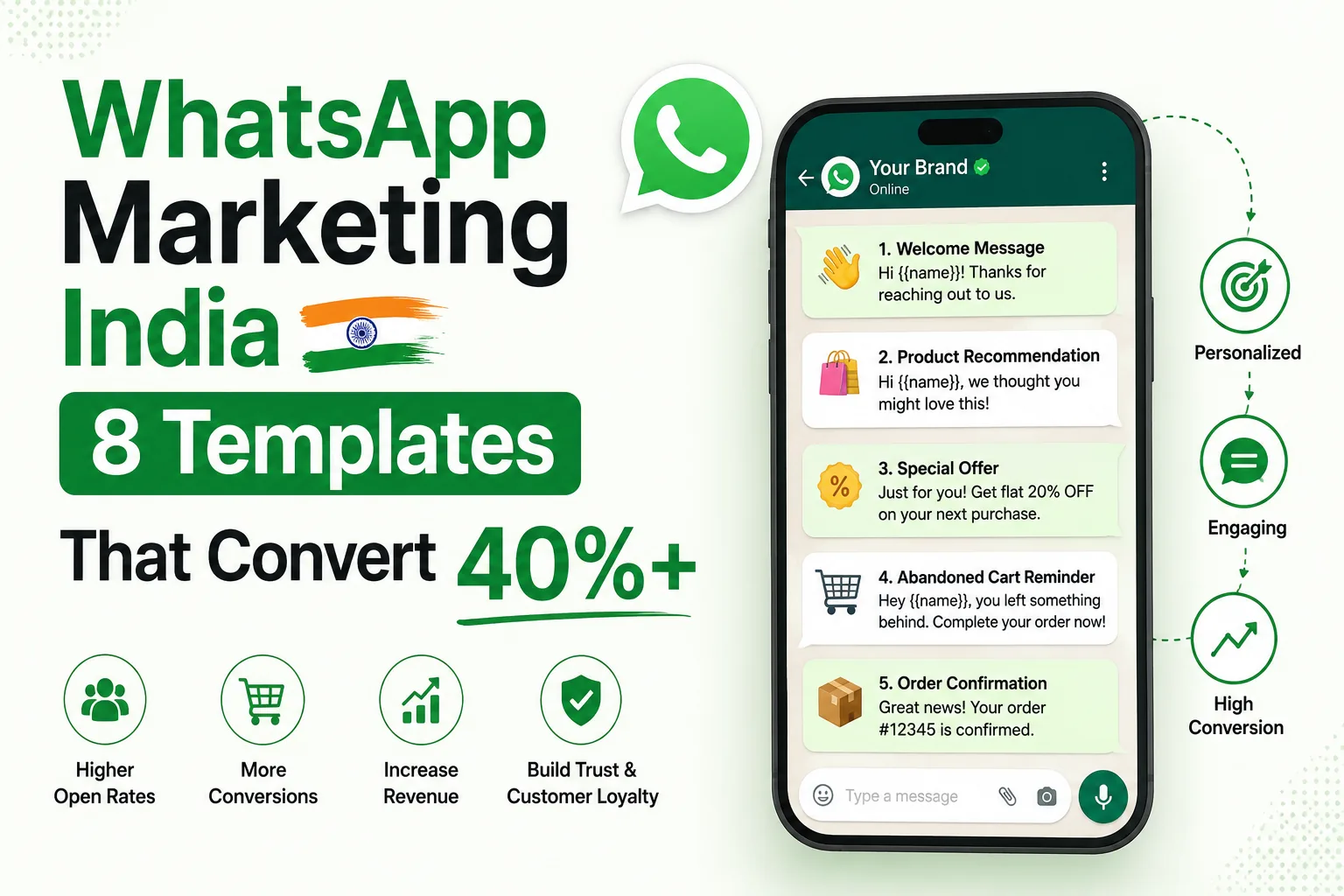
Here are 8 proven WhatsApp marketing India templates you can copy, customize, and deploy today.
📱 Want DigiVeritaz to set up your WhatsApp marketing services engine? We build high-converting WhatsApp flows for Indian brands.
1. The Welcome Sequence (New Subscriber Onboarding)
Your welcome message sets the tone for every interaction that follows. The highest-converting welcome sequences use a 3-message drip:
- Message 1 (immediate): Thank them, set expectations for message frequency, and offer an instant incentive (10% off first order).
- Message 2 (Day 1): Share your bestseller or most popular service with social proof (reviews, ratings).
- Message 3 (Day 3): Ask a qualifying question to segment them for future campaigns.
Brands using this 3-step welcome flow see 57% higher first-purchase conversion than those sending a single welcome message.
💡 Pro Tip: Always include an opt-out option in your first message. This builds trust and actually increases long-term engagement rates because people who stay opted in are genuinely interested.
2. Abandoned Cart Recovery (70% Recovery Rate)
WhatsApp abandoned cart messages recover up to 70% of abandoned carts — compared to email's 5–15% recovery rate. The key is timing and personalization.
Send the first recovery message within 1 hour of cart abandonment. Include the product image, name, and price. Add a one-tap "Complete Purchase" button that takes them directly to checkout with their cart pre-loaded. If they don't convert within 24 hours, send a second message with a small incentive (free shipping or 5% off).
💡 Pro Tip: Include the customer's first name and the specific product image in every recovery message. Personalized WhatsApp recovery messages convert 3x higher than generic "you left something behind" templates, especially when combined with effective e-commerce marketing services.
3. Flash Sale Broadcast (48-Hour Urgency Campaign)
WhatsApp flash sale broadcasts outperform email and SMS by 5–10x on conversion because of the 98% open rate. Structure your flash sale as a 3-message sequence:
- Message 1 (Launch): Announce the sale with specific discounts and a countdown timer.
- Message 2 (12 hours): Reminder + bestseller highlight — share which products are selling fastest.
- Message 3 (Final 2 hours): Last-chance message with remaining stock numbers.
The real-time urgency combined with WhatsApp's immediacy creates conversion rates that other channels simply cannot match — though pairing each broadcast with paid awareness channels like native advertising helps you reach buyers who aren't yet on your list.
💡 Pro Tip: Send flash sale messages during peak engagement windows: 9:00–11:00 AM and 6:00–9:00 PM IST. Messages sent during these windows see 20–35% higher engagement than off-peak sends.
4. Post-Purchase Feedback Loop (NPS + Review Collection)
Send a WhatsApp message 3–5 days after delivery asking for a quick rating (1–5 stars via button taps). For customers who rate 4–5 stars, automatically trigger a Google/Amazon review request with a direct link. For customers who rate 1–3 stars, route them immediately to customer support.
This template turns every satisfied customer into a review contributor and catches negative experiences before they become public complaints.
💡 Pro Tip: Add a small incentive for leaving a review (₹50 store credit works well). The cost is negligible compared to the lifetime value of authentic reviews that drive future conversions.
5. Re-Engagement Campaign (Win Back Dormant Customers)
Segment customers who haven't purchased in 60–90 days. Send a personalized "We miss you" message referencing their last purchase category. Include an exclusive comeback offer (higher discount than your standard promotions) with a 48-hour expiration.
The personal touch of WhatsApp combined with purchase-history personalization creates a 25–35% reactivation rate — far exceeding email win-back campaigns that typically achieve 5–10%.
💡 Pro Tip: Reference their specific last purchase in the message: "Hi [Name], how did you like the [Product]? We've got something new in [Category] you'll love." Specificity doubles response rates.
6. Lead Qualification Chatbot Flow (B2B/Services)
For service businesses, build a WhatsApp chatbot that qualifies leads through a 4-question sequence:
- What service are you interested in?
- What's your monthly budget range?
- When do you want to start?
- What's the best time for a quick call?
This pre-qualifies leads before they reach your sales team, saving hours of back-and-forth. 57% of new leads for service businesses using this flow are generated entirely through automated WhatsApp conversations.
💡 Pro Tip: Use quick-reply buttons for each question instead of asking open-ended questions. Button taps are 4x faster than typing and increase completion rates from 30% to 75%, making them a valuable part of broader performance marketing services.
7. Event/Webinar Registration & Reminder Sequence
WhatsApp reminders achieve near-perfect attendance rates compared to email reminders. Build a 4-message sequence:
- Registration confirmation with calendar add link.
- 24-hour reminder with agenda highlights.
- 1-hour reminder with join link.
- Post-event follow-up with recording and next-step CTA.
Education companies and SaaS brands using this sequence report 80%+ attendance rates vs. 30–40% with email-only reminders.
💡 Pro Tip: Include a "Reply with your biggest question about [topic]" prompt in the 24-hour reminder. This creates engagement and gives presenters audience-specific content to address.
8. Catalog Showcase with Click-to-Buy (E-Commerce)
Use WhatsApp's native catalog feature to showcase 5–10 products with images, descriptions, and prices. Send curated collections based on customer segments: "New Arrivals for You," "Bestsellers Under ₹999," or "Back in Stock." Each product card includes a direct "Add to Cart" action.
Brands using WhatsApp catalogs report 27% higher average order values compared to standard website browsing because the curated, personalized presentation reduces decision fatigue.
💡 Pro Tip: Create 3–5 different catalog collections for different customer segments. Send the "premium" catalog to high-LTV customers and the "value picks" catalog to price-sensitive segments. Segmented catalogs convert 2x better than one-size-fits-all.
Frequently Asked Questions
Is WhatsApp marketing legal in India?
Yes, provided you follow opt-in compliance. Users must explicitly opt in to receive marketing messages. The WhatsApp Business API enforces this through template message approvals. Always include an opt-out option in every broadcast.
What is the best time to send WhatsApp marketing messages in India?
Peak engagement windows are 9:00–11:00 AM and 6:00–9:00 PM IST. Messages sent during these windows see 20–35% higher engagement. However, transactional messages (order confirmations, delivery updates) perform well regardless of timing.
How much does WhatsApp Business API cost in India?
Conversation-based pricing starts at approximately ₹0.35–₹0.75 per conversation, depending on the category (utility, marketing, or service). Most SMBs spend ₹5,000–₹25,000/month on WhatsApp API messaging costs.
What is a good conversion rate for WhatsApp marketing?
Top-performing WhatsApp campaigns achieve 40–60% click-through rates and 15–30% purchase conversion rates. The benchmark varies by industry, but any WhatsApp campaign converting below 10% likely has segmentation or messaging issues.
Should I use WhatsApp Business App or WhatsApp Business API?
Use the free Business App if you have fewer than 256 contacts and low message volume. Migrate to the API when you exceed broadcast limits, need CRM integration, require multi-agent access, or want chatbot automation. 35% of Business App users plan to migrate to API within 12 months.