
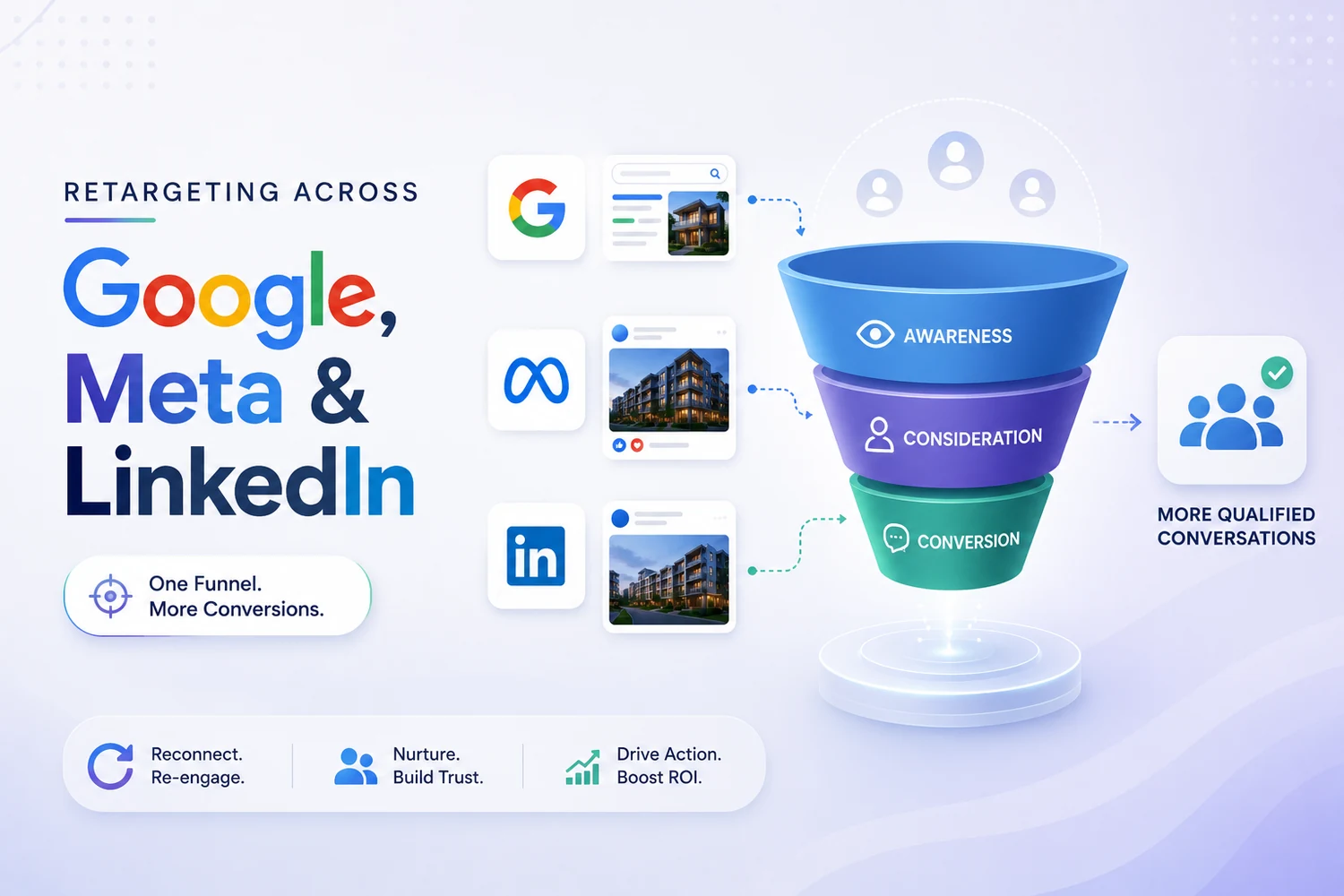
Most Indian brands retarget in silos: a Google campaign here, a Meta campaign there, a LinkedIn effort running separately, none of them talking to each other. The result is a disjointed experience where the same prospect sees repetitive, uncoordinated ads across platforms. A unified retargeting funnel does the opposite, treating Google, Meta, and LinkedIn as one connected system that guides a buyer from first touch to conversion. Here is how to build it, based on how we design cross-channel display advertising and social funnels.
Why silos waste money
When your retargeting platforms operate independently, they overlap and collide. The same person gets bombarded on Meta while being ignored on Google, frequency spirals out of control on one channel, and your message never progresses logically. This fragmentation wastes budget on redundant impressions and creates a jarring experience that can actually harm your brand. Recognising that siloed retargeting is quietly inefficient is the first step toward a smarter, unified approach.
Map the funnel before the platforms
A unified funnel starts not with channels but with stages: awareness, consideration, and decision. Define what a prospect needs at each stage and what action should move them to the next, then decide which platform best serves each moment. Mapping the journey first, and assigning platforms to roles second, is what turns three separate ad accounts into one coherent system that walks a buyer forward rather than shouting at them from three directions.
Assign each platform its strength
Each platform excels at a different job. Meta is powerful for broad awareness and visually driven consideration; Google captures high intent and re-engages searchers and site visitors; LinkedIn reaches decision-makers with professional precision for B2B. In a unified funnel, you deliberately use each where it is strongest rather than running the same generic retargeting everywhere, so the whole becomes far greater than the sum of its parts.
Sequence the message across stages
The heart of a unified funnel is message sequencing. A prospect who just discovered you should see an awareness message, and once they engage, the next platform should advance the story toward consideration, then decision, rather than repeating the same ad. Coordinating creative so each touch builds on the last turns retargeting from nagging repetition into a persuasive narrative that matches where the buyer actually is in their thinking.
Control frequency across channels
Frequency management is much harder across platforms, yet it is where unified thinking pays off most. Without coordination, a prospect might see your ad far too often in total, breeding irritation rather than interest. By planning total exposure across Google, Meta, and LinkedIn together, you keep frequency in a healthy range, ensuring your brand stays present and welcome rather than overbearing and easy to resent.
Unify measurement and attribution
You cannot manage a unified funnel with siloed reporting. Bring your data together so you can see how platforms assist one another, understanding that Meta awareness may drive a Google-attributed conversion later. Measuring the funnel as a whole, rather than crediting whichever platform touched last, reveals the true contribution of each channel and stops you defunding the top-of-funnel work that quietly powers your conversions.
Build first-party data as the connective tissue
In a privacy-first 2026, your own first-party data is what holds a cross-platform funnel together. Clean audience lists, website events, and CRM signals let you coordinate retargeting reliably as third-party tracking fades. Investing in this data asset is what makes unified retargeting durable, and building it is central to how our performance marketing team future-proofs client funnels against ongoing signal loss.
A simple starting sequence
If a full cross-platform funnel feels daunting, start small and build. Begin by connecting your data across two platforms rather than three, coordinate a single clear message sequence from awareness to decision, and set a sensible total frequency cap between them. Once that two-platform funnel runs smoothly and you can see how the channels assist each other, add the third and refine your sequencing. This staged rollout gives you a working, coordinated system quickly, rather than stalling on the complexity of unifying everything at once. Most Indian brands find that even a partial unification immediately outperforms the fragmented setup they started with.
The DigiVeritaz takeaway
A unified retargeting funnel is not about running more ads; it is about running coordinated ones, so every touch across Google, Meta, and LinkedIn moves the buyer forward rather than merely reminding them you exist. Map the journey, assign platforms to their strengths, sequence the message, and measure the whole, and your retargeting becomes a system rather than a scatter of disconnected campaigns. DigiVeritaz builds unified, cross-channel funnels as part of measurable, ROI-driven social media advertising and search for Indian brands across 7 industries.