
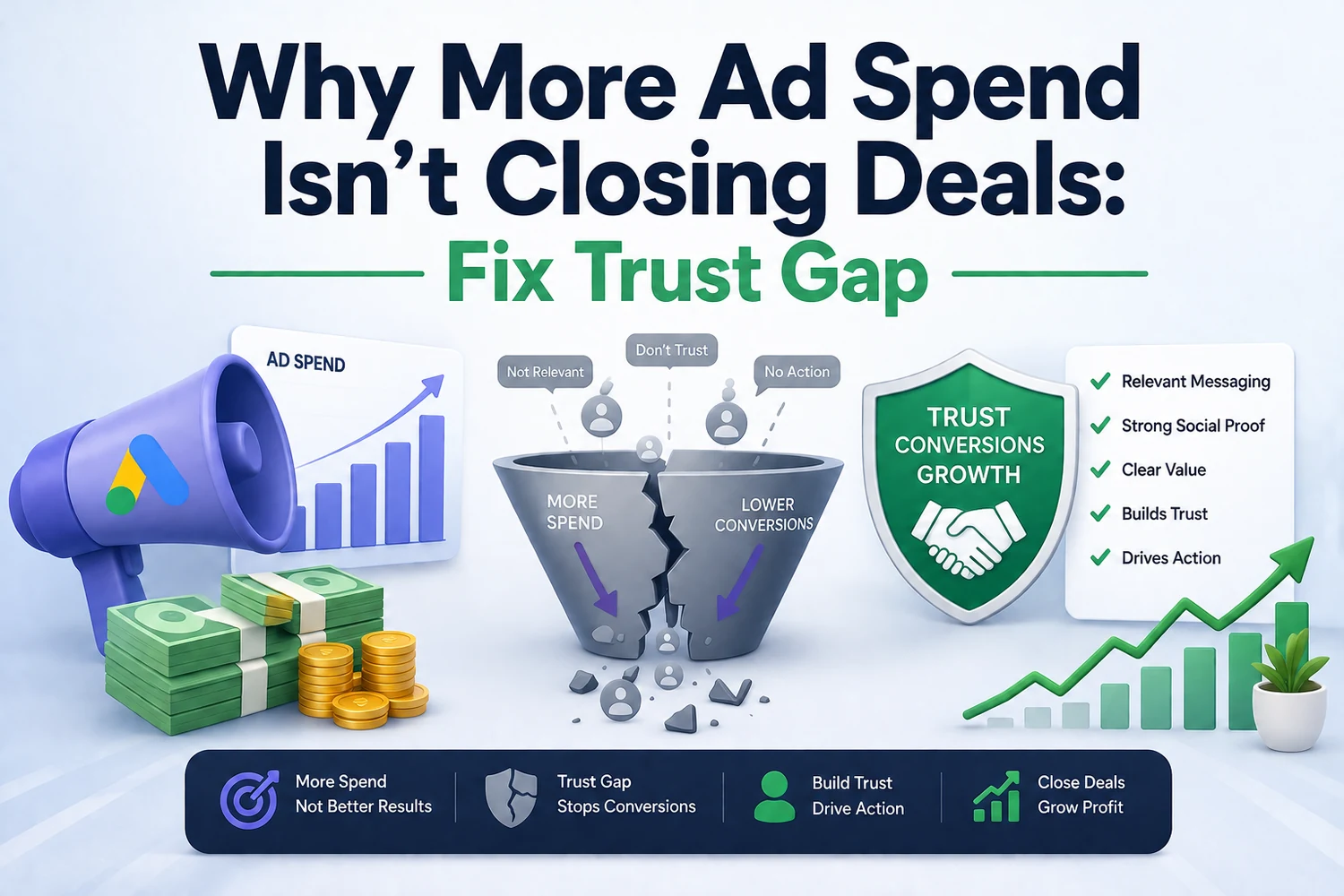
Many Indian brands are spending more on ads than ever before while seeing conversion rates flatten or fall. The instinct is to blame the platform, the creative or the sales team. The real problem is often something deeper: prospects do not trust the claims your ads are making, so more spend just amplifies a broken message. Here is how to diagnose and fix the trust gap.
The Trust Gap Explained
The trust gap is the space between what your marketing claims and what your prospects believe. In 2020, brands could make broad promises — ‘India’s #1 platform,’ ‘trusted by 10,000 businesses,’ ‘guaranteed results’ — and see acceptable conversion rates because trust in advertising was still relatively intact. In 2026, buyers have been through years of exaggerated claims, AI-generated content and outright deception. Their default posture toward marketing is skepticism, and their default response to unsupported claims is to disengage. Ad spend does not close the gap; it just delivers more skeptical prospects to a sales team that has to overcome the disbelief before it can sell.
How to Recognise the Trust Gap in Your Funnel
Five signals reveal the trust gap at work. First, high click-through rates on paid ads combined with low form-fill rates on landing pages — clicks are curiosity, not commitment. Second, high form-fill rates combined with high no-show rates on sales calls — leads engage tentatively then disengage. Third, sales cycles that have lengthened significantly over the past two years without a corresponding increase in deal size. Fourth, an increase in prospects asking for extensive proof, references and pilots before committing. Fifth, a rising cost per closed deal even when cost per lead has held steady. These are not sales-team problems; they are trust problems that show up in the sales stage.
The Four Trust Signals That Close Deals in 2026
First, verifiable specificity — replace ‘we help businesses grow’ with ‘we generated 12,400 qualified leads for HDFC in Q1 2026.’ Specific claims with dates and names are trust anchors. Second, third-party validation — media coverage, industry awards, verified reviews and case studies with named clients build more trust than any brand-owned claim. Third, transparent process — showing the actual method you use to deliver results, not just the outcome, signals that you have nothing to hide. Fourth, honest limitations — clearly stating what you do not do, who is not a fit and where your service has boundaries. This last one feels counter-intuitive but consistently outperforms broad-claim positioning in 2026.
Rebuilding Trust in Your Marketing Assets
Start with your top-of-funnel ads. Rewrite headlines to replace category claims with specific proof points. Replace hero images with authentic imagery of real work or real teams. Move testimonials from generic quotes to specific outcomes with named clients where possible. Then rework your landing pages. Move social proof above the fold. Add a clear, honest description of your process. Add an FAQ that addresses the objections real prospects raise. Finally, update your sales collateral. Case studies with real numbers close more deals than case studies with impressive prose. Combining these fixes with sustained digital PR and structured conversion rate optimisation produces measurable improvement in downstream conversion rates within 60–90 days.
How to Measure Trust as a Marketing Metric
Trust is not a soft metric. Track it directly. Measure your ad-to-lead conversion rate over time. Measure the ratio of qualified to unqualified leads from each channel. Survey prospects at the point of first sales contact — a single question like ‘what almost stopped you from getting in touch’ surfaces the trust barriers your marketing did not overcome. Track branded search volume as a trust indicator; growing branded search means people are talking about you and looking you up before contact. And track close rates by lead source, because trust gaps often concentrate in specific channels where messaging and reality diverge most.
Working With DigiVeritaz
DigiVeritaz builds trust-first marketing programmes for Indian brands that combine paid media, digital PR, content and conversion optimisation to close the gap between claim and belief. Our approach starts with a diagnostic of where trust breaks down in your funnel and then rebuilds each stage with specificity, proof and honesty as the design principles. Book a free trust gap audit to see where your marketing is spending money on skeptical clicks and what to fix first.
Frequently Asked Questions
What is the trust gap in marketing?
The trust gap is the space between what your marketing claims and what your prospects actually believe. Since 2020, buyer skepticism toward advertising has increased dramatically, and unsupported claims now reduce rather than drive conversion.
How do I know if I have a trust gap?
Common signs include high click-through rates paired with low form-fills, high form-fills paired with high no-shows, lengthening sales cycles without larger deals, and rising cost per closed deal even when cost per lead has held steady.
How long does rebuilding trust take?
Measurable improvement in downstream conversion rates typically appears within 60 to 90 days of a comprehensive trust-focused rebuild covering ads, landing pages, sales collateral and case studies with specific proof points.
Is honest limitation really more effective than broad claims?
Yes, consistently. Clearly stating what you do not do, who is not a fit and where your service has boundaries signals credibility and consistently outperforms broad category claims in 2026 buyer research.
Explore our lead generation services or contact us.