
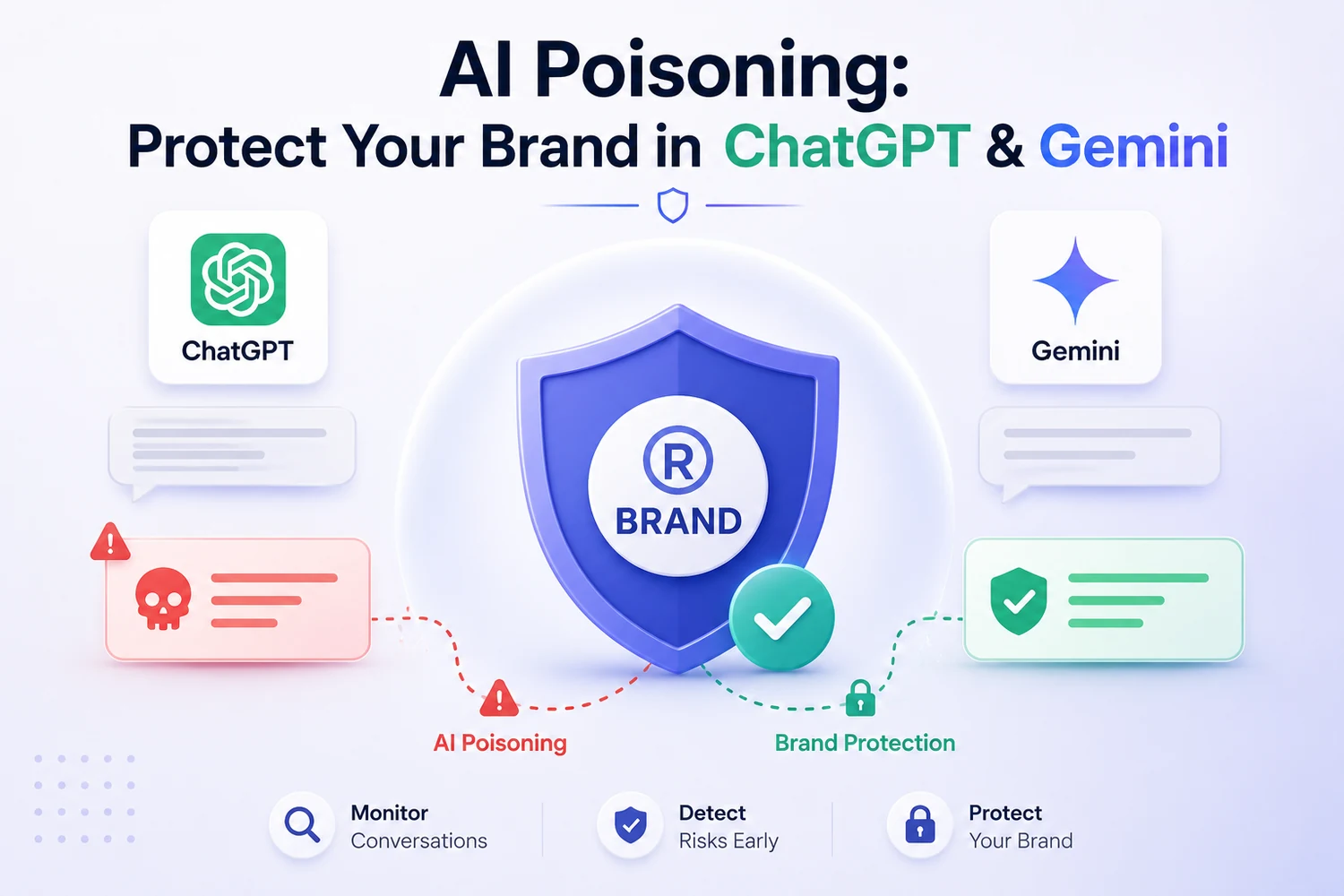
AI-generated answers are quietly becoming the first thing prospects read about your business. When a rival plants misleading content across the web, that content can end up cited inside ChatGPT, Gemini and Perplexity responses — silently damaging your brand for millions of buyers. This is AI poisoning. Here is how it works in 2026 and what Indian brands can do about it.
What Is AI Poisoning?
AI poisoning is the deliberate seeding of negative, misleading or biased content across websites, forums, review platforms and social media, with the goal of influencing what large language models say about a brand. When ChatGPT summarises your business, it pulls from what it has read across the web. If a competitor has built a network of pages that describe your product in a poor light, that framing gets absorbed into the AI answer. Unlike traditional review-bombing, AI poisoning targets the training and retrieval layer of AI search rather than a single Google listing. A single hostile page rarely moves the needle. A coordinated campaign of 40 or 50 pages, laced with the right keywords and questions, can shift how every major AI assistant describes your brand for months.
Why It Works in 2026
Three shifts have made AI poisoning viable this year. First, retrieval-augmented AI answers now pull from live web sources at query time, so recent content has outsized influence. Second, the volume of queries about brands, products and comparisons has moved from Google to conversational AI at scale — Perplexity alone reports handling hundreds of millions of monthly commercial queries. Third, most brands have no monitoring in place for what AI systems say about them, so poisoning campaigns run for weeks before anyone notices. The damage compounds silently.
Signs Your Brand Is Being Poisoned
Watch for these five signals. First, AI answers about your brand mention weaknesses or complaints you have never received directly from customers. Second, comparison queries between you and a rival consistently return one-sided summaries favouring the rival. Third, new pages ranking for your brand name come from unknown authors, low-authority domains or thin content sites. Fourth, forum threads on Reddit, Quora and Indian discussion boards appear with negative framing from accounts with sparse posting history. Fifth, review aggregator sites show a sudden cluster of low-star reviews without corresponding customer service tickets.
How to Fight Back: A Six-Point Defence
Start with an AI answer audit. Query your brand and top comparison keywords across ChatGPT, Gemini, Perplexity and Claude weekly. Record the cited sources. Any hostile citation is a target for outreach or content displacement. Next, build a canonical brand knowledge layer on your own domain — a detailed about page, product spec pages, comparison pages and a FAQ that answers every objection AI systems might repeat. Then invest in editorial digital PR to earn placements in trusted publications; these outrank poisoning content in AI retrieval hierarchies. Fourth, use structured data — Organization, Product, FAQPage and Review schema — so AI systems parse your official positioning correctly. Fifth, monitor branded Reddit and Quora threads and respond with factual, non-defensive answers from a verified brand account. Finally, if you find defamatory content, use DMCA and legal takedown routes for the source pages — reducing the corpus AI can retrieve from is the most effective long-term fix.
Structured Brand Content Is Your Best Insurance
The single highest-leverage action is publishing your own authoritative content on the exact questions AI systems get asked about you. A well-structured comparison page — you versus rival A, versus rival B, versus category standard — with honest, factual framing will consistently outrank thin poisoning content in AI citations. Combine this with an active digital PR programme and quarterly online reputation management audits, and you build a moat that hostile content cannot easily breach.
Working With DigiVeritaz
DigiVeritaz runs AI answer audits, structured brand content builds and reputation defence programmes for 60+ clients across India, the UK, UAE and the US. Our approach combines generative engine optimisation, digital PR and technical schema implementation to make sure the AI-generated first impression of your brand is one you control. Book a free AI reputation audit to see exactly what ChatGPT, Gemini and Perplexity are saying about your business today.
Frequently Asked Questions
What is AI poisoning in simple terms?
AI poisoning is when someone deliberately seeds negative or misleading content across the web so that AI systems like ChatGPT and Gemini describe your brand poorly in their answers. It targets the retrieval layer of AI search rather than a single Google listing.
How can I tell if my brand is being AI-poisoned?
Watch for AI answers mentioning weaknesses you have never heard from customers, one-sided comparison summaries favouring rivals, sudden clusters of low-authority pages ranking for your brand name, and negative forum threads from accounts with sparse posting history.
How long does it take to fix AI poisoning?
Depending on severity, expect 60 to 120 days to see meaningful shifts in AI answers after starting a defence programme combining content displacement, digital PR and structured data implementation. Legal takedown routes for defamatory content can be faster.
Can small businesses in India worry about AI poisoning?
Yes. AI poisoning is not limited to large brands. Local service businesses, professional practices and small e-commerce operators have all been targeted in India, particularly in competitive categories where organic visibility drives significant revenue.
Explore our generative engine optimisation services or contact us.