
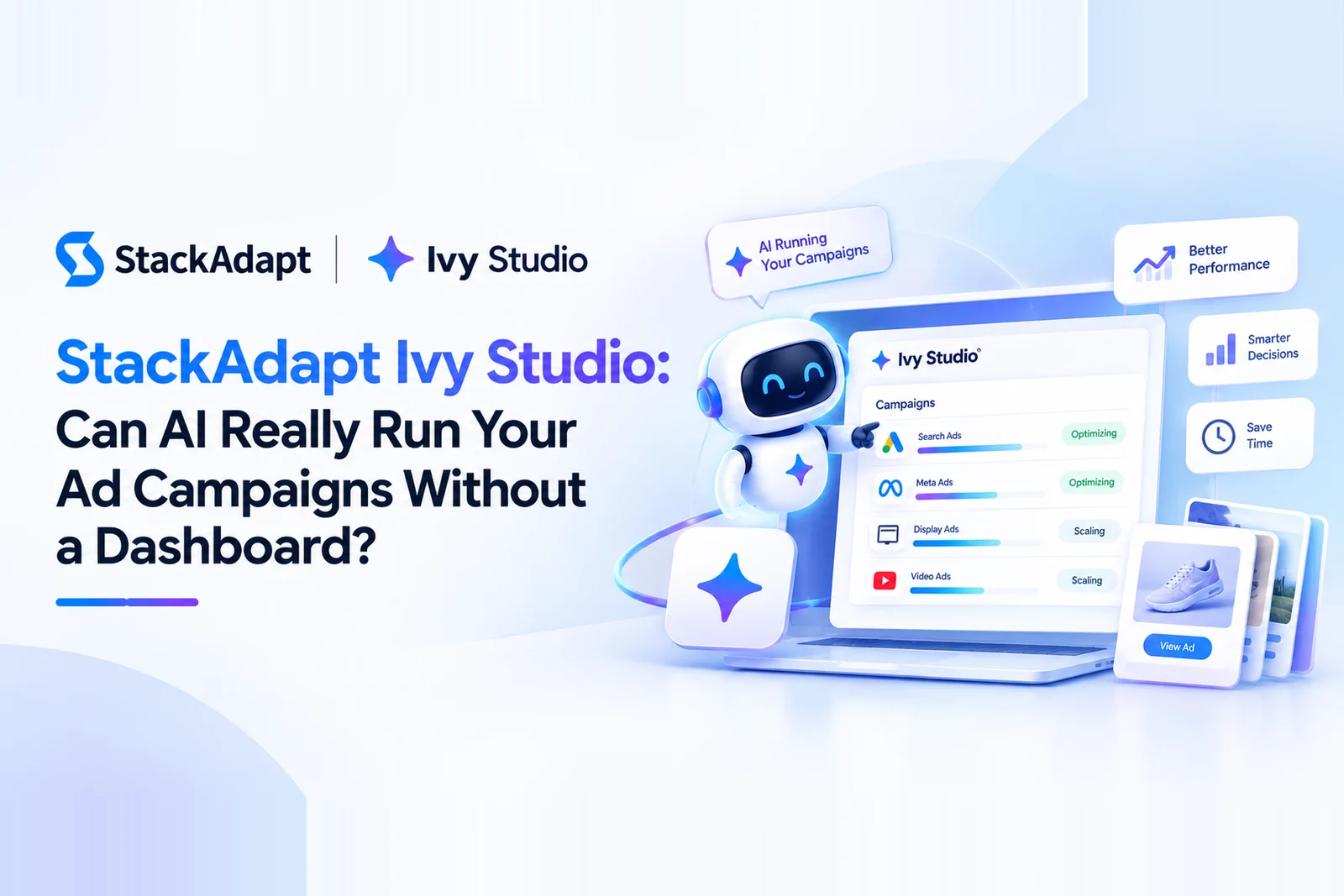
StackAdapt has launched Ivy Studio, an AI-driven advertising system that aims to manage programmatic ad campaigns through goal-based instructions rather than manual dashboard management. Instead of checking charts and adjusting bids, you tell Ivy your business objective and it makes campaign decisions automatically. For Indian performance marketing teams drowning in manual optimisation work, this is a significant proposition, if it actually delivers. Here is what Ivy Studio does and how to evaluate it.
What Ivy Studio Actually Does
Ivy Studio is StackAdapt's AI layer sitting above its programmatic advertising platform. Rather than requiring campaign managers to manually review placement performance, adjust audience bids and rotate creatives through a traditional dashboard, Ivy accepts natural-language business goals, such as 'generate qualified leads for our enterprise SaaS product at under INR 2,500 per lead', and makes campaign management decisions in real time to pursue those goals. It suggests budget reallocations, flags underperforming placements and executes approved optimisations without requiring the user to interpret data tables first.
Why Dashboard-Free Ad Management Is an Interesting Proposition
The promise is compelling because traditional programmatic ad management has a genuine operational burden problem. Effective programmatic campaign management requires constant monitoring across dozens of metrics, including viewability, brand safety, frequency, placement performance, audience segment performance and creative rotation, that take significant analyst time to interpret and act on. If an AI layer can reliably handle the monitoring and basic optimisation decisions, campaign managers can focus on strategy, creative and client communication rather than dashboard management. For small to mid-sized Indian marketing teams, this efficiency gain could be meaningful.
Where AI-Driven Campaign Management Has Historically Fallen Short
The history of 'AI will run your campaigns automatically' products is mixed. Google's Smart Campaigns and Meta's Advantage+ have both shown that AI automation can outperform manual management on narrow, well-defined objectives with sufficient conversion data, and significantly underperform when objectives are ambiguous, conversion signals are weak or brand safety constraints are not properly configured. Ivy Studio faces the same fundamental challenge. AI campaign management is only as good as the objective definition and the conversion data it optimises toward. Vague goals or poor tracking produce poor automated decisions regardless of the sophistication of the AI layer.
How to Evaluate Whether Ivy Studio Is Right for Your Campaigns
Four conditions need to be true before AI-managed programmatic is likely to outperform manual management. First, your conversion events need to be clearly defined and accurately tracked, because AI cannot optimise toward a goal it cannot measure. Second, your monthly campaign volume needs to be sufficient for the algorithm to learn, and programmatic AI systems typically need 50 or more conversion events per month to optimise meaningfully. Third, your business objective needs to be expressible as a specific, measurable outcome rather than a broad aspiration. Fourth, your team needs to retain oversight capability, meaning the ability to review what the AI is doing, understand its decisions and override them when strategic requirements differ from optimisation signals. Pairing any AI-managed campaign system with robust analytics configuration ensures the tracking foundation is solid enough for the AI to make reliable decisions.
The Right Way to Test Ivy Studio
Run Ivy Studio as a parallel test alongside an existing manually-managed programmatic campaign for 60 days, allocating comparable budget and objectives to each. Compare cost per acquisition, lead quality and brand safety outcomes across the two. Let the test run its full duration rather than making reactive judgements in the first two weeks when the AI is still in its learning phase. For Indian brands offering digital marketing services in Mumbai or nationally, this test-and-measure approach, rather than wholesale adoption, protects client budgets while generating real performance evidence. Combine results with your existing pay-per-click data for a like-for-like comparison, and make sure your team retains the manual campaign management skills needed if the test does not produce the promised results.
Working With DigiVeritaz on Programmatic Advertising
DigiVeritaz evaluates and manages programmatic advertising for Indian brands, including emerging AI-driven platforms like StackAdapt Ivy Studio, with a rigorous test-and-measure approach rather than uncritical adoption of any platform's automation claims. Book a free programmatic advertising audit to see how your current programmatic campaigns are performing and whether AI management tools would improve results.
Frequently Asked Questions
Is StackAdapt available for Indian advertisers?
StackAdapt is a DSP operating globally and is accessible to Indian advertisers and agencies with sufficient programmatic budgets. Minimum spend thresholds vary by market and relationship type.
What makes Ivy Studio different from Google's Performance Max?
Both use AI to automate campaign management, but Ivy Studio operates across programmatic inventory beyond Google's ecosystem. Performance Max is Google-inventory-only. Ivy Studio is positioned as platform-agnostic programmatic automation.
What happens if Ivy Studio makes a bad budget decision?
Spend controls and daily budget caps limit the damage from poor automated decisions. This is why configuring hard budget limits before deploying any AI-managed campaign system is essential. The system should not be able to exceed defined parameters without human approval.
Should I replace my campaign managers with Ivy Studio?
No. AI campaign management handles optimisation decisions within a defined framework. Strategy, creative direction, goal setting and client communication still require human expertise. AI tools increase what a campaign manager can oversee, not replace the role.
Explore our performance marketing services or contact us.