
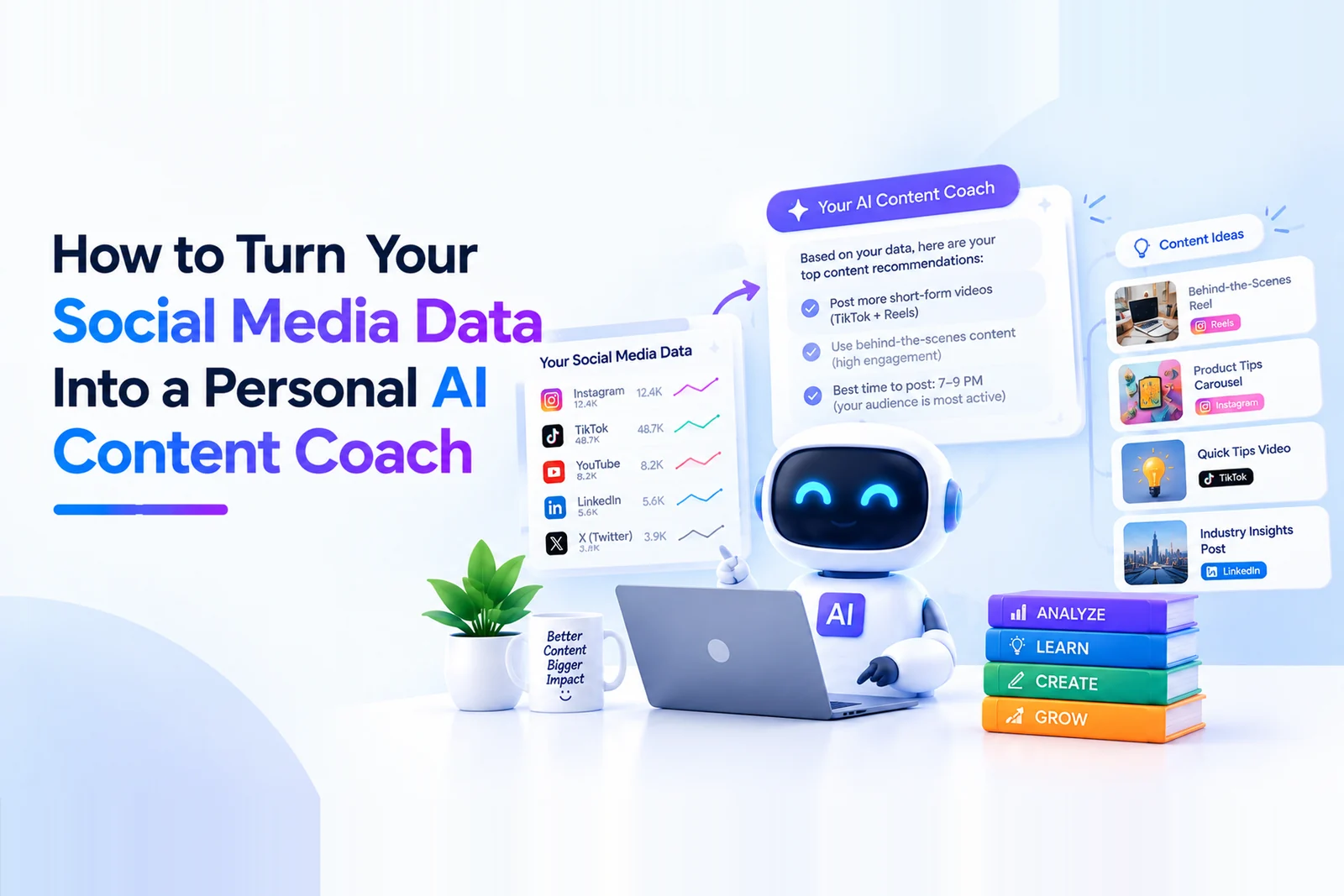
A practical new approach to social media strategy is gaining traction: downloading your own post performance data, feeding it into an AI tool and asking it to identify patterns and act as a content coach tailored to your specific account. Unlike generic social media advice, this approach is grounded in your actual audience's behaviour on your specific account. Here is how to build your own AI content coach in under two hours.
Why Your Own Data Is More Valuable Than Generic Benchmarks
Most social media advice is built around aggregate data from large datasets, meaning what works on average across millions of accounts. Your audience is not average. Your followers have specific interests, behaviours and consumption patterns that differ from the mean in ways that generic benchmarks cannot capture. When you feed your actual post performance data, covering specific engagement rates, reach numbers, top-performing content types and worst-performing formats, into an AI tool and ask it to find patterns specific to your account, the advice you get back is grounded in what your audience has actually responded to rather than what a typical audience tends to prefer.
Step One: Downloading Your Performance Data
Each major platform provides export options for historical post performance. Instagram allows export through its professional dashboard, Facebook through the Insights export function, LinkedIn through the Analytics section's data export, and Twitter/X through the Analytics export. Buffer and Hootsuite both offer cross-platform performance exports if you use a scheduling tool. Download at minimum the past 90 days of post data, aiming for 180 days or more if available. Include all available metrics: reach, impressions, engagement rate, saves, shares, link clicks and any video-specific metrics like completion rate and watch time. The more data you include, the more specific the AI's pattern recognition can be.
Step Two: Structuring the AI Prompt for Coaching
Simply uploading the data and asking 'what should I do' produces generic output. Structure your prompt to be specific. Include your business context, meaning what you sell and who you sell to, your specific goal, whether that is more followers, more website traffic, more leads or more engagement, the date range of the data, and three to four specific questions you want answered. For example, 'which content formats generate the most saves?' or 'does posting time affect my reach significantly?' Ask the AI to identify your three best-performing content patterns and your three worst, then recommend a specific posting plan for the next four weeks based on those findings. This structured approach extracts strategy from data rather than just description.
Interpreting What the AI Finds
AI pattern analysis on social media data consistently surfaces four types of insight. First, format patterns, meaning which content types such as carousel, video, single image or text-only consistently outperform your average. Second, topic patterns, meaning which subject areas generate above-average engagement for your specific audience. Third, timing patterns, meaning whether specific posting windows correlate with stronger reach or engagement on your account. Fourth, hook patterns, meaning which types of opening lines or visual hooks in top-performing posts appear repeatedly. Each of these is actionable in your next posting cycle without requiring external research. Combining these insights with disciplined content marketing planning translates the coaching output into a structured, measurable calendar.
Making This a Monthly Practice
The value of the AI content coach approach compounds when it becomes a monthly practice rather than a one-off exercise. Download data monthly, run the analysis, update your content plan based on findings and track whether performance improves. Over three to four months, this iterative loop builds a clear picture of what genuinely works for your specific audience rather than what generic industry advice suggests should work. Indian brands working with a digital marketing agency for social media should expect this kind of account-specific data analysis to inform their content recommendations rather than strategy built purely on platform-wide benchmarks.
Working With DigiVeritaz on Data-Led Social Strategy
DigiVeritaz builds social media content strategies grounded in account-specific performance data for Indian brands, using both AI analysis tools and human editorial judgement to translate data patterns into content plans that perform. Book a free social media data audit to see what your own posting history reveals about what your audience actually responds to.
Frequently Asked Questions
How much data do I need for the AI coaching approach to work well?
A minimum of 90 days of post data across at least 30 posts per platform provides enough pattern data for useful analysis. More data, particularly 6 to 12 months, produces richer and more reliable insights, especially for detecting seasonal patterns.
Which AI tool works best for this analysis?
ChatGPT, Claude and Gemini all handle this type of data analysis well. Upload the CSV export from your social platform, provide the context prompt and ask specific questions about patterns. The quality of the output depends more on your prompt structure than on which specific AI tool you use.
What format should I export the data in?
Most social platforms export performance data as CSV files. Upload these directly to your AI tool of choice. If the platform offers multiple export options, choose the one with the most granular post-level data rather than aggregate summaries.
Can this replace working with a social media agency?
For tactical content optimisation decisions, the AI coaching approach provides genuinely useful guidance. It does not replace strategic direction, creative production, community management, paid social management or competitive analysis that a social media agency provides.
Explore our social media management services or contact us.