
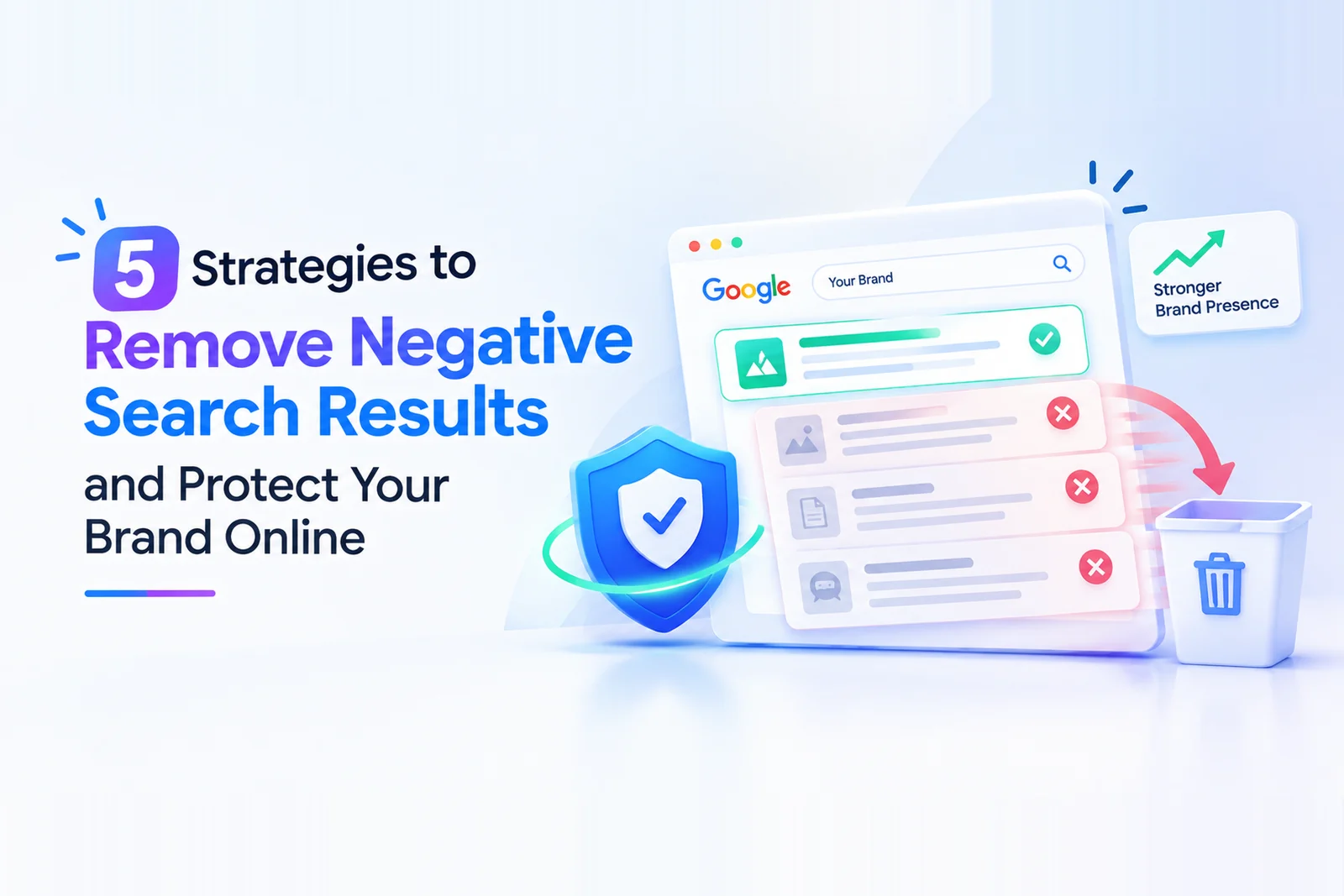
A negative search result appearing on the first page of Google for your brand name is one of the most damaging things that can happen to your online presence, and it is far more common than most Indian businesses realise. Negative reviews, critical articles, forum complaints and competitor-planted content all show up in brand searches. Here are five strategies to remove or suppress them, ordered from fastest to most sustainable.
Strategy One: Direct Removal Through Legal Routes
The fastest way to remove negative content is to get it taken down at the source. This applies to content that is factually false, defamatory, violates a platform's terms of service or infringes copyright. File a formal complaint with the hosting platform's content moderation team and, where content is demonstrably false and damages your business, send a legal notice to the content owner and the hosting platform. Google also accepts removal requests for specific categories of harmful content through its Legal Removal Request form, covering revenge content, doxxing, fraudulent content and content that violates court orders. While this route can be slow and uncertain, a successful removal eliminates the problem entirely rather than pushing it down the results page.
Strategy Two: Google's Own Removal Tools
Google provides specific removal routes for defined content categories directly through Search Console and its dedicated removal request forms. Outdated content that no longer exists at its original URL can be removed from Google's cache using the outdated content removal tool. Personal information like home addresses, financial details and medical information qualifies for removal through Google's personal information removal request. Sexually explicit content published without consent is also removable directly. For business reputation content such as negative articles and critical reviews, Google's own tools do not apply, and the other strategies below are required.
Strategy Three: Content Suppression Through Positive Publishing
For negative content that cannot be removed, the practical alternative is building enough high-quality, positive content to push it off the first page of results for your brand name. Google's first page for any brand typically has ten results. Owning eight or more of those slots with your own web properties, social profiles, positive news coverage and directory listings makes the negative result effectively invisible for most users who search. This requires a deliberate digital PR and content publishing programme. Building your LinkedIn, Glassdoor, YouTube and Wikipedia presence alongside your owned website pages creates a broad positive footprint that suppresses negative results over three to six months.
Strategy Four: Review Profile Strengthening
Negative review content on platforms like Google, Glassdoor, Justdial and AmbitionBox is among the most damaging for Indian brands because it appears prominently in brand searches and is trusted by users. The most effective long-term response is building such a volume of genuine positive reviews that the negative ones are statistically diluted. A systematic, policy-compliant review generation programme, asking satisfied customers to share their experience through a simple, timed outreach sequence, is more defensible and more sustainable than any reactive response to individual negative reviews. Responding to every review, positive and negative, with a professional and specific reply also signals active management to potential customers. Our 8-step ORM framework covers how to build that review engine and the monitoring around it.
Strategy Five: SEO-Driven Suppression of Specific URLs
When a specific negative URL consistently outranks your own content for your brand name, the SEO solution is to strengthen the pages you want to rank above it. That means building internal links to your target pages from across your own site, earning external links to those pages through editorial PR, and improving the content depth and structured data on the pages you want to displace the negative result. This approach, combined with consistent content publishing across multiple owned and earned platforms, typically pushes negative search results below the fold within 90 to 180 days depending on the domain authority of the negative source. Indian brands seeking digital marketing services in Mumbai or nationally should treat brand SERP management as a standard component of ongoing SEO work rather than a crisis-response activity.
Working With DigiVeritaz on Online Reputation Management
DigiVeritaz runs online reputation management programmes for Indian brands, combining legal removal, positive content publishing, review generation and brand SERP SEO into a single integrated approach. Book a free brand SERP audit to see what appears on the first page of Google for your brand name and which of the five strategies apply to your situation.
Frequently Asked Questions
How long does it take to remove a negative result from Google?
Direct legal removal or Google's own removal tools can act within days to weeks for qualifying content. Content suppression through positive publishing typically takes three to six months to move a negative result off the first page for brand name searches.
Can I remove a negative Google review?
Only if it violates Google's review policies, meaning spam, fake, off-topic or containing prohibited content. Honest negative reviews reflecting genuine customer experiences cannot be removed. The appropriate response is a professional reply and a programme to generate more positive reviews.
What if a competitor is planting negative content about my brand?
Document the evidence of competitor origin, then pursue both platform reporting (most platforms prohibit competitor interference) and legal routes. This is a specific form of the issue where legal removal combined with digital PR suppression is the most effective combined approach.
Does responding to negative reviews help with Google rankings?
Review responses are a trust signal that Google's local ranking algorithm considers, and they influence how human readers evaluate the negative review. A thoughtful, specific response to a negative review often neutralises its reputational impact more effectively than leaving it unaddressed.
Explore our online reputation management services or contact us.