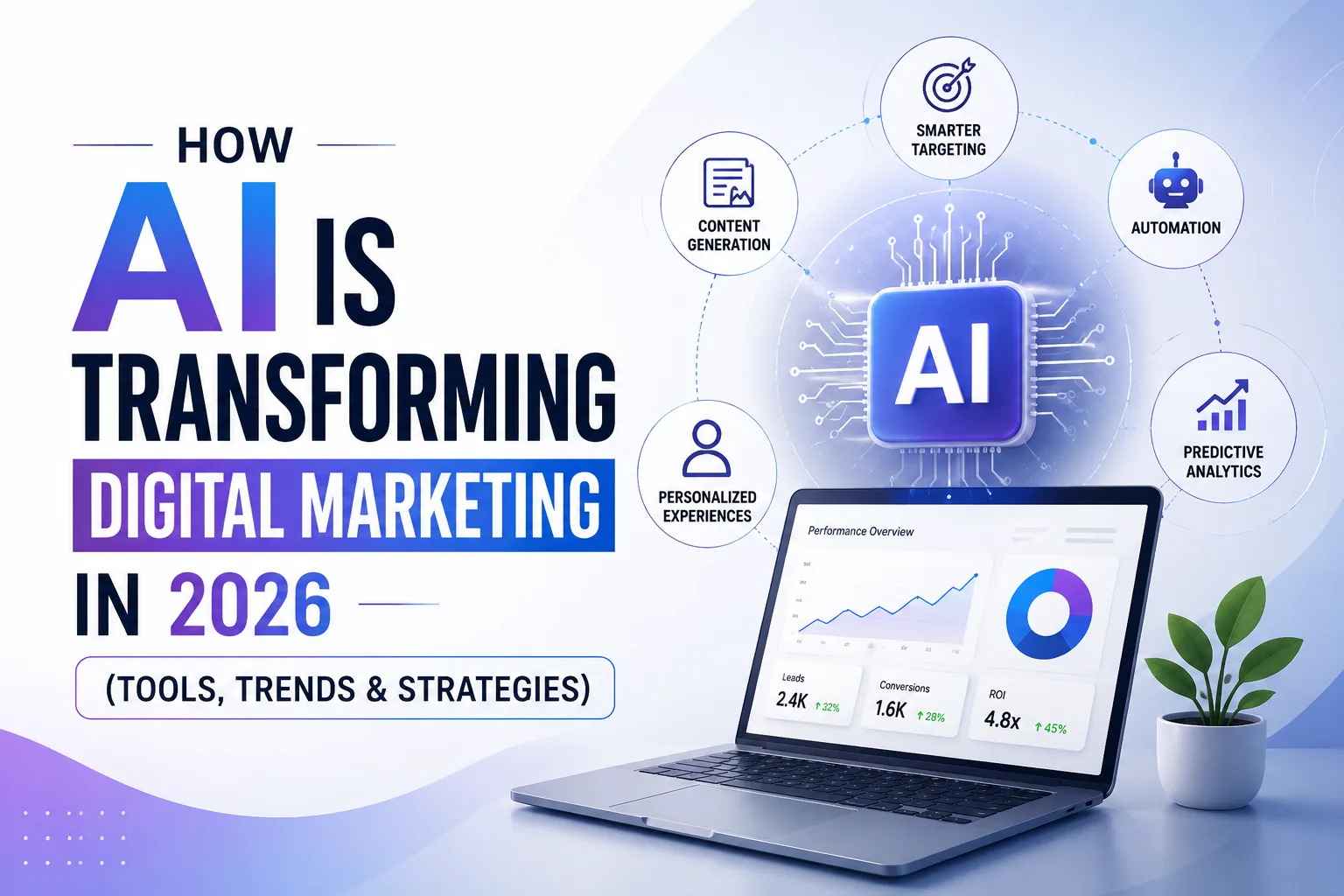
Artificial intelligence is no longer a futuristic concept — it is the backbone of every high-performing digital marketing strategy in 2026. From automating repetitive tasks to predicting what your next customer will buy, AI in digital marketing has fundamentally changed how brands attract, engage, and convert their audiences.
Whether you are a startup, a local business, or a growing brand, understanding how AI in marketing works — and which tools and strategies to adopt — is now a competitive necessity. This guide breaks it all down in practical, ROI-focused terms.
What Is AI in Digital Marketing
Definition
AI in digital marketing refers to the use of artificial intelligence technologies — including machine learning, natural language processing, and predictive analytics — to automate decisions, personalize experiences, and optimize marketing performance at a scale that is impossible for human teams alone.
In simple terms: AI takes the data your marketing generates, learns from it continuously, and uses those learnings to make smarter decisions faster — whether that is serving the right ad to the right person at the right time, or predicting which leads are most likely to convert.
Role of AI in Modern Marketing
AI plays three primary roles in digital marketing in 2026: automation of repetitive tasks, personalization of customer experiences at scale, and data analysis that surfaces insights human analysts would miss. Together, these capabilities allow marketing teams to do more with less budget and produce measurably better results across every channel.
| Traditional Marketing | AI in Digital Marketing |
|---|---|
| Manual campaign setup | Automated, AI-optimized campaigns |
| Broad audience targeting | Hyper-personalized audience segmentation |
| Weekly/monthly reporting | Real-time data analysis and insights |
| Reactive decision-making | Predictive analytics and forecasting |
| Static ad creatives | Dynamic, AI-generated ad variations |
| Generic customer journeys | Individualized personalization at scale |
How AI Is Changing Marketing Strategies
Marketing Automation
Marketing automation powered by AI has moved far beyond scheduled email sends. In 2026, AI-driven automation manages entire customer journeys — triggering the right message, on the right channel, at the right moment based on real-time behavioral signals. AI marketing tools can automatically pause underperforming ad campaigns, reallocate budgets to high-performing segments, and adjust bidding strategies to hit target cost per lead goals without human intervention.
For small businesses and agencies, marketing automation eliminates hours of manual campaign management each week — freeing teams to focus on strategy and creative while AI handles execution and optimization.
Personalization at Scale
Personalization has always been the holy grail of marketing — but delivering it consistently at scale was previously impossible. AI in digital marketing solves this. Machine learning models analyze thousands of data points per user — browsing behavior, purchase history, content engagement, location, and device type — to serve individualized content, product recommendations, and ad experiences to every visitor.
Brands using AI-driven marketing personalization report an average 20% increase in conversion rate and up to 40% higher email open rates compared to generic broadcast campaigns. Personalization is no longer a premium feature — it is the baseline expectation in 2026.
KEY STAT — 80% of consumers say they are more likely to make a purchase when brands offer personalized experiences. AI in digital marketing makes this personalization possible at any business size — not just enterprise brands with massive data teams.
Key AI Tools Used in Marketing
Chatbots
AI-powered chatbots are one of the highest-ROI AI marketing tools available today. Modern chatbots do far more than answer basic FAQs — they qualify leads, book appointments, recover abandoned carts, and guide visitors through complex buying decisions, all without human involvement. Businesses that deploy AI chatbots on their websites report a 20 to 35% increase in qualified leads and significant reductions in cost per acquisition.
- Intercom and Drift — conversational AI for B2B lead qualification and sales acceleration
- ManyChat — automated lead capture and nurturing on WhatsApp, Instagram, and Facebook
- Tidio — AI chatbot designed for small business e-commerce and service websites
AI Content Tools
AI content tools have transformed how marketing teams produce and optimize content at scale. These tools assist with blog drafts, ad copy, social media posts, email subject lines, and SEO meta tags — dramatically reducing content production time without sacrificing quality. However, the most effective marketing teams use AI content tools to accelerate human-led creation, not replace it entirely.
- Jasper AI — long-form blog content and ad copywriting with brand voice customization
- Surfer SEO — AI-powered content optimization for on-page SEO and keyword coverage
- Copy.ai — rapid ad copy, email subject lines, and social media content generation
- Google's Performance Max — AI-driven ad creation and cross-channel campaign optimization
Benefits of AI in Marketing
Efficiency and Cost Reduction
The most immediate benefit of AI in marketing is operational efficiency. Tasks that previously consumed entire workdays — audience segmentation, A/B test analysis, bid optimization, content ideation, and performance reporting — are now handled automatically. Marketing teams using AI tools report saving 10 to 20 hours per week on execution tasks, allowing them to focus on strategy, creativity, and client relationships.
For growing brands and agencies, this efficiency multiplier is transformative. AI allows a small team to manage campaign volumes that previously required significantly larger headcount — directly improving margins and ROI on marketing investment.
Data Analysis and Predictive Intelligence
Human analysts can review historical data and surface patterns — but AI can process millions of data points in real time and make predictions about future behavior. Predictive analytics powered by machine learning identifies which leads are most likely to convert, which customers are at risk of churning, and which content topics will drive the most organic traffic in the coming months.
For digital marketing in 2026, predictive analytics is not a luxury — it is what separates brands that react to trends from brands that anticipate and shape them.
Challenges of Using AI in Marketing
Over-Reliance on Automation
The biggest risk of AI in digital marketing is treating it as a replacement for human strategy rather than a tool that augments it. Over-automated campaigns can feel robotic, fail to adapt to cultural moments, and produce content that lacks the authentic brand voice that builds genuine customer relationships. The most effective AI-powered marketing still has human judgment at the strategic level — AI executes, humans direct.
Data Quality and Privacy Issues
AI is only as good as the data it learns from. Poor data quality — incomplete records, biased training datasets, or inaccurate conversion tracking — produces poor AI decisions. Equally important are data privacy regulations: GDPR, India's Digital Personal Data Protection Act (DPDPA), and platform-level restrictions on third-party cookies are actively reshaping what data AI systems can access and use. Brands must build first-party data strategies now to maintain AI effectiveness as third-party data sources diminish.
DIGIVERITAZ — DigiVeritaz builds AI-powered marketing strategies that balance automation efficiency with authentic human strategy. Our clients see measurable improvements in lead quality and ROI within 60 days. Book a free strategy session at digiveritaz.com.
Future of AI in Marketing
Key Trends for 2026
- Generative AI for creative — AI now drafts, tests, and iterates ad creatives autonomously based on performance data
- Voice search optimization — AI-powered voice assistants are changing how consumers search, requiring conversational keyword strategies
- AI-powered SEO — tools like Surfer SEO and Clearscope now guide content creation in real time based on SERP analysis
- Hyper-personalization — AI models serve individualized landing pages, emails, and ad experiences at the individual user level
- Predictive lead scoring — machine learning models rank every lead by conversion probability, allowing sales teams to prioritize high-value prospects
AI-Driven Campaigns in 2026
The defining characteristic of AI-driven campaigns in 2026 is full-funnel intelligence. AI does not just optimize individual ads or emails in isolation — it orchestrates the entire customer journey across every channel simultaneously. A prospect who clicks a Google Ad is automatically served a matched retargeting sequence on Instagram, a personalized email within 2 hours, and a chatbot conversation when they return to the website — all coordinated by AI with no manual intervention.
For agencies and in-house marketing teams, this shift means the competitive advantage no longer lies in who has the most people running campaigns — it lies in who has the best AI systems, the cleanest first-party data, and the sharpest human strategy guiding the machine.
Frequently Asked Questions
Q: What is AI in marketing?
A: AI in marketing refers to using artificial intelligence technologies — including machine learning, predictive analytics, and natural language processing — to automate decisions, personalize customer experiences, and optimize campaign performance at scale.
Q: How does AI help digital marketing?
A: AI helps digital marketing by automating repetitive tasks like bid management and reporting, enabling personalization at scale, improving data analysis speed and accuracy, powering chatbots for 24/7 lead capture, and generating AI-driven campaigns that continuously self-optimize for better ROI.
Q: What are the best AI marketing tools in 2026?
A: Top AI marketing tools include Google Performance Max for paid campaigns, Jasper AI for content creation, Surfer SEO for on-page optimization, Intercom and ManyChat for chatbot lead generation, and HubSpot AI for CRM automation and lead scoring.
Q: Is AI replacing digital marketers?
A: No — AI is replacing specific manual tasks, not strategic thinking. The most effective digital marketing teams in 2026 combine AI automation for execution with human expertise for strategy, creativity, and brand direction. AI amplifies great marketers; it does not replace them.
Explore More from DigiVeritaz
- Performance Marketing Strategy — AI-powered campaigns built for measurable lead generation and ROI
- SEO Services in India — AI-enhanced organic search strategies for consistent traffic growth
- Google Ads Services — Smart bidding and AI-optimized PPC campaigns for maximum ROAS
- Lead Generation Services India — Full-funnel AI-driven lead generation for startups and SMBs
- Digital Marketing Agency in India — End-to-end performance marketing powered by AI tools
Conclusion
AI in digital marketing is not a trend you can afford to observe from the sidelines. In 2026, it is the infrastructure that separates high-performing marketing teams from those that are being outpaced. From marketing automation and chatbots to predictive analytics and AI-driven campaigns, the tools are accessible, the results are measurable, and the competitive gap between adopters and non-adopters is widening every month.
Ready to integrate AI into your marketing? DigiVeritaz builds AI-driven campaigns and AI marketing tools strategies for startups and growing brands across India. Book your free strategy session at digiveritaz.com.
