
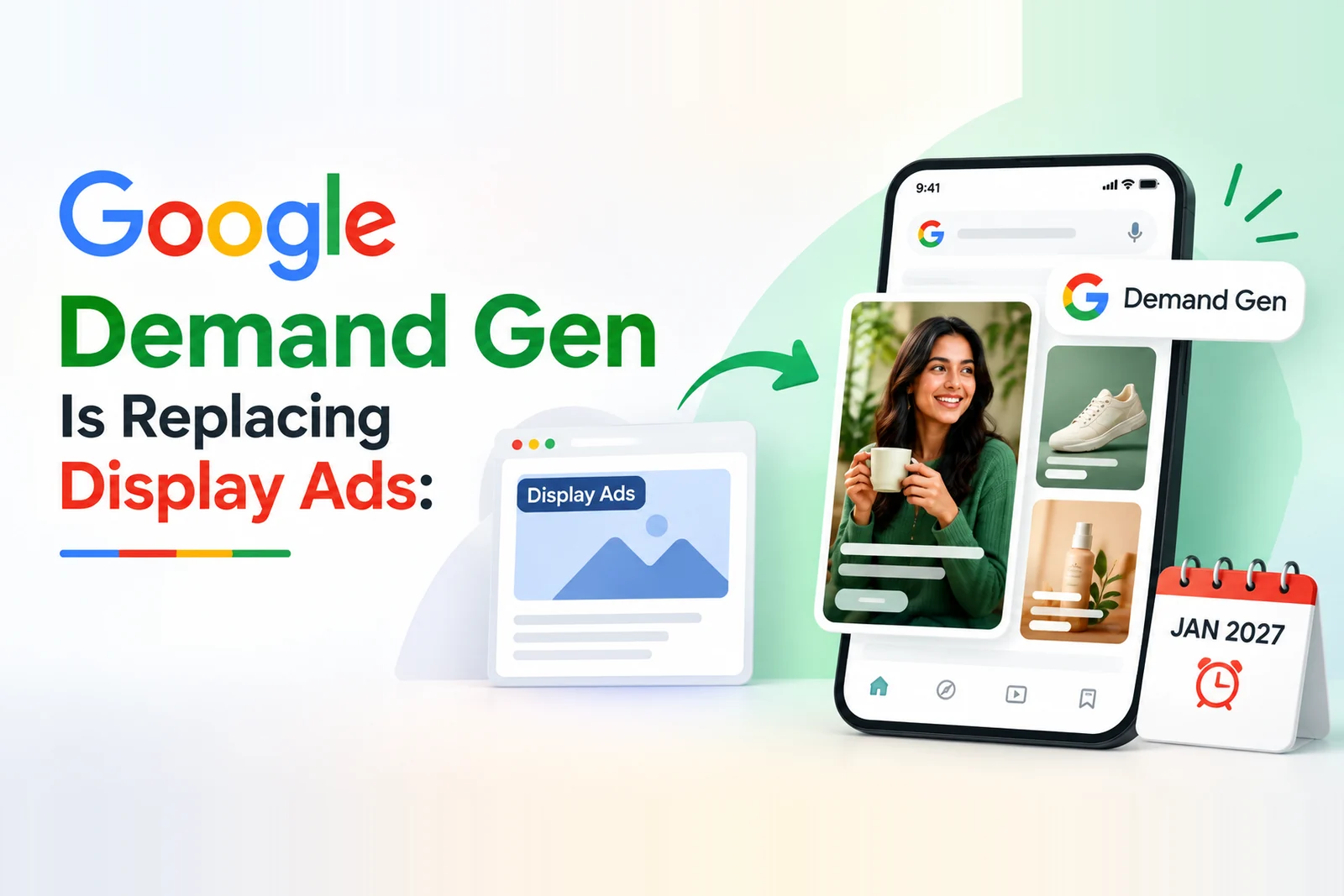
Google has confirmed that its traditional visual ad campaigns — previously managed through Display and Video 360 and standard Google Ads visual placements — will be migrated to Demand Gen by January 2027. After that date, existing visual campaigns will be automatically switched and no new traditional visual campaigns can be created. For Indian advertisers running display and video budgets, this is a mandatory transition with real performance implications if handled without preparation.
What Demand Gen Actually Is
Demand Gen is Google's AI-driven campaign type designed to generate awareness and consideration by placing creative across YouTube (including Shorts and in-feed placements), Discover feed and Gmail — all within a single campaign. Unlike traditional Display campaigns where advertisers define placements and audiences manually, Demand Gen uses Google's AI to match creative to audiences based on intent signals and interest data, giving the algorithm significantly more placement control than advertisers previously had.
What Changes When Your Campaigns Are Migrated
Three significant changes come with the Demand Gen migration. First, placement control shifts from manual selection to AI-driven matching, meaning your ads will appear where Google's algorithm decides rather than exclusively where you chose. Second, bidding moves to Demand Gen's automated strategies — Maximise Conversions or Target CPA — rather than the manual or enhanced CPC approaches many display advertisers have used historically. Third, creative requirements expand significantly: Demand Gen performs best with multiple creative formats including portrait, square and landscape imagery plus video, whereas traditional Display campaigns often ran on static images alone. If that pattern sounds familiar, it is the same trade Google made when it moved Local Service Ads into Performance Max.
Six Actions to Take Before January 2027
First, audit all active visual ad campaigns and map them to equivalent Demand Gen structures now, rather than accepting whatever Google's automatic migration produces. Second, review your creative library for gaps — do you have portrait and square image variants and at least one 15- to 30-second video asset for each campaign? Third, ensure conversion tracking is correctly configured for the objectives Demand Gen optimises toward, since quality conversion signals drive AI performance. Fourth, set realistic Target CPA goals based on historical visual campaign cost per conversion. Fifth, run parallel Demand Gen campaigns alongside existing visual campaigns for 60 days before the migration deadline to generate learnings. Sixth, brief internal stakeholders on the change in placement control so reporting expectations are updated. A structured performance marketing review should accompany any major campaign structure change of this scale.
The Creative Investment Demand Gen Requires
The single biggest risk in the Demand Gen migration is entering it with insufficient creative variety. Google's AI needs multiple creative formats to test and optimise — campaigns with only one or two static image assets consistently underperform campaigns with five or more creative combinations across formats and messaging angles. This migration is a compelling reason to invest in a dedicated creative production batch before January, producing portrait, square and landscape variants of key assets alongside short-form vertical video — work that connects directly to your broader branding and design standards.
Whether Demand Gen Will Actually Perform Better
For most awareness and consideration objectives, Demand Gen is designed to outperform manual display campaigns over time because the AI placement decisions are informed by richer intent data than manual audience targeting could access. However, performance during the learning period is typically weaker than established campaigns, and brands expecting a seamless performance handover will be disappointed — the same reach-versus-control trade-off that Performance Max forced on Shopping advertisers. Plan for a 30 to 60 day learning phase and evaluate performance over a 90-day window rather than the first two weeks. Indian brands looking for digital marketing services in Mumbai or nationally should ask their agency specifically how they plan to manage the Demand Gen transition for active visual campaigns.
Working With DigiVeritaz on Demand Gen Migration
DigiVeritaz is preparing all Indian client accounts for the Demand Gen migration with campaign structure planning, creative asset audits, conversion tracking verification and parallel campaign testing before the January 2027 deadline. Book a free paid media migration audit to see what your current visual campaigns need before the automatic switch happens.
Frequently Asked Questions
When does the Demand Gen migration happen?
Google has indicated January 2027 as the date after which traditional visual campaigns cannot be created and existing ones will be automatically migrated. Active preparation should begin well before Q4 2026.
Will my ads stop running during the migration?
Existing campaigns will be automatically migrated by Google — they will not simply stop. However, the migration may change campaign settings in ways that affect performance, which is why reviewing and preparing campaigns before the automatic switch is strongly recommended.
Do I need video assets for Demand Gen to work?
Video assets are strongly recommended. Demand Gen with video significantly outperforms Demand Gen with static images alone because it can access YouTube inventory. A minimum of one 15-to-30-second video per campaign is the practical starting point.
Will Demand Gen cost more than my current display campaigns?
Cost per impression and cost per click may differ from legacy display campaigns during the learning phase. Over a 90-day period, most advertisers see performance stabilise at comparable or better levels than their previous display campaigns, particularly for awareness and consideration objectives.
Explore our Google Ads services or contact us.