
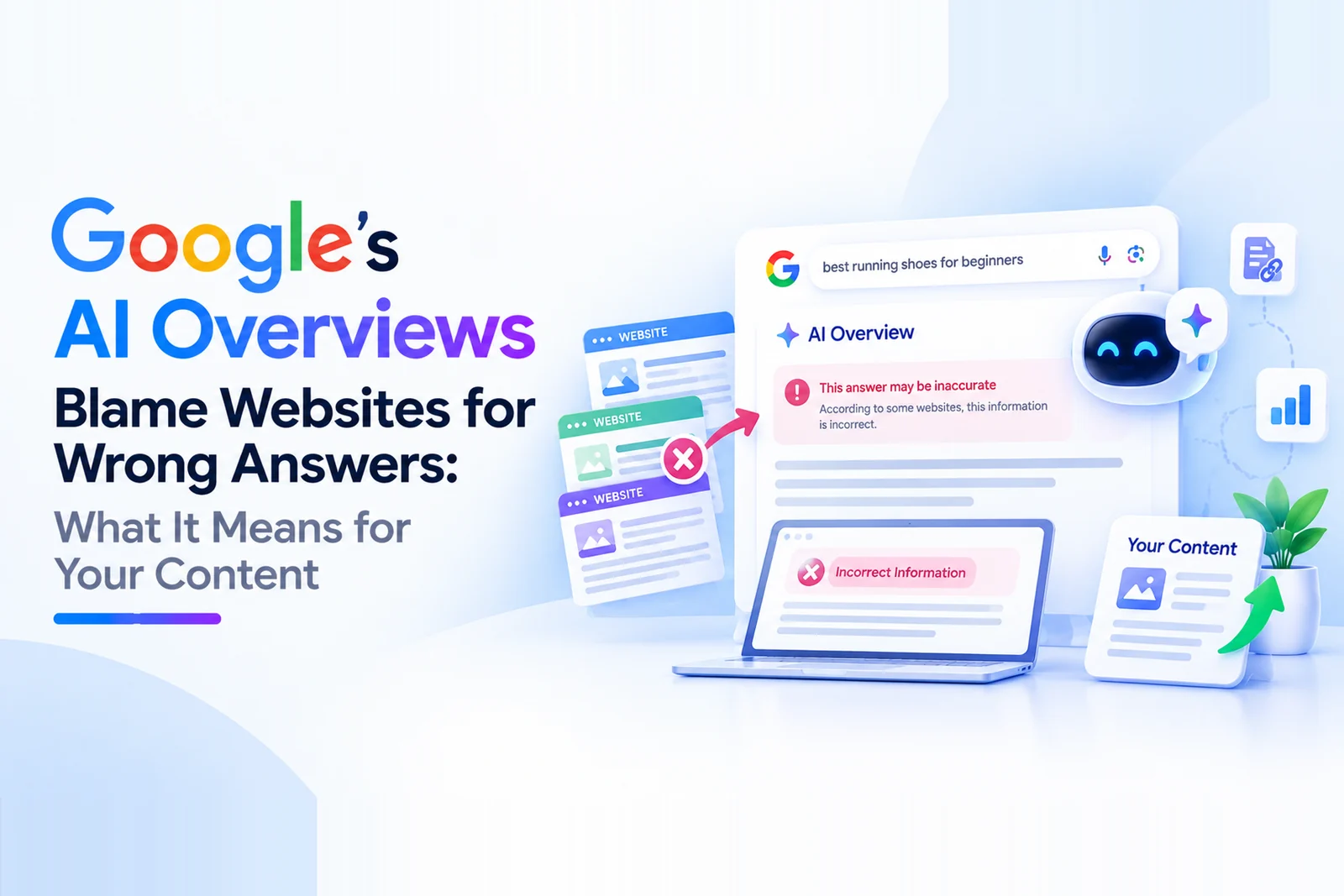
When Google's AI Overviews produced a problematic answer about race this week, Google's response was to point to the source websites as the origin of the incorrect information, rather than acknowledging it as an AI system failure. This response pattern has significant implications for Indian brands whose content is being used to power AI answers. Here is what content accountability in the AI search era actually means for your brand.
What Google's Response Actually Signals
When Google attributed the problematic AI Overview answer to source websites, it was doing two things simultaneously: deflecting responsibility from its own AI system, and signalling its position on content liability in the AI search era. If Google's frame becomes settled, meaning that AI Overviews faithfully reflect what source websites publish and websites bear responsibility for what they contribute to AI answers, then the content brands publish online carries a new accountability dimension beyond its direct SEO or audience value. Content that contains errors, outdated claims or misleading framing can end up amplified through AI answers at a scale far beyond what the original page could generate on its own.
Why Content Accuracy Now Matters More Than Before
Before AI search, an inaccurate claim in a blog post was read by however many people visited that page. In the AI search era, the same inaccurate claim can be extracted, synthesised and presented as an authoritative AI answer to thousands of searchers daily, potentially without the caveats, context or correction links that would appear on the original page. For brands, this means content inaccuracies can create reputational damage at an entirely different scale and speed than was previously possible from a single page. A factual error in a technical article or a dated statistic in a case study can persist in AI answers long after the original page is corrected.
Conducting a Content Accuracy Audit
Run a quarterly content accuracy audit covering your five highest-traffic and most-linked pages. Check that statistics are current and sourced with dates. Verify that product or service claims still accurately reflect your current offering. Confirm that any regulatory, legal or technical claims reflect current requirements rather than historical ones. Add visible 'last reviewed' dates to content that is regularly updated, which signals to both human readers and AI systems that the content is actively maintained rather than published-and-forgotten. A disciplined content marketing programme that includes a content maintenance cycle is the operational mechanism for keeping your AI-cited content accurate.
What to Do When Your Content Is Cited in Wrong AI Answers
If you discover that an AI Overview is citing your content in an answer you believe is incorrect or misleading, two parallel actions are available. First, update your source content to correct the inaccuracy, since AI systems that use live retrieval will pick up the correction over time, though this is not instantaneous. Second, submit feedback on the specific AI Overview answer through Google's interface, which routes to their content quality team. Documenting the issue and your corrective actions is also prudent in case the answer creates reputational damage that requires a response. Pair this with online reputation management monitoring that specifically checks whether your brand is being cited in AI answers and in what context.
The Broader Lesson for AI Search Strategy
Google's response confirms a framework that Indian brands should build their content strategy around: you are responsible for what your content says, and AI systems will amplify what you publish at a scale you cannot fully control. This makes the case for investing in higher-quality content, meaning more accurate, better sourced and more carefully reviewed, even more compelling than it already was for traditional SEO. And it makes the case for digital PR that earns citations in genuinely authoritative sources rather than publishing on your own domain alone, since AI systems weight trusted third-party citations as more authoritative than owned media.
Working With DigiVeritaz on Content Quality
DigiVeritaz builds content accuracy review processes and content quality programmes for Indian brands, ensuring that what gets cited in AI answers represents the brand well rather than creating reputational risk. Book a free content audit to see which of your highest-traffic pages contain accuracy, currency or framing issues that could be amplified by AI search.
Frequently Asked Questions
Can I tell Google not to use my content in AI Overviews?
Yes. Adding a nosnippet meta tag to specific pages prevents Google from showing snippets from those pages, including in AI Overviews. However, this also removes your content from standard search snippets, which is a trade-off to evaluate carefully.
How do I find out if my content is being cited in AI Overviews?
Search for your target queries in Google and observe whether AI Overviews appear. Where they do, check whether your domain is listed as a source. Tools like Semrush and Ahrefs also track AI Overview citation data for tracked keywords.
What should I do if an AI Overview contains an error from my old content?
Update the source content immediately to correct the error. Submit feedback on the specific AI Overview through Google's interface. Request re-indexing of the updated page through Search Console so Google processes the correction faster.
Does Google fact-check content before including it in AI Overviews?
Google applies quality signals to source selection but does not independently verify every factual claim in cited content. The quality of the AI Overview answer is directly dependent on the accuracy of the content it draws from, which is why content accuracy is a brand responsibility.
Explore our content marketing services or contact us.