
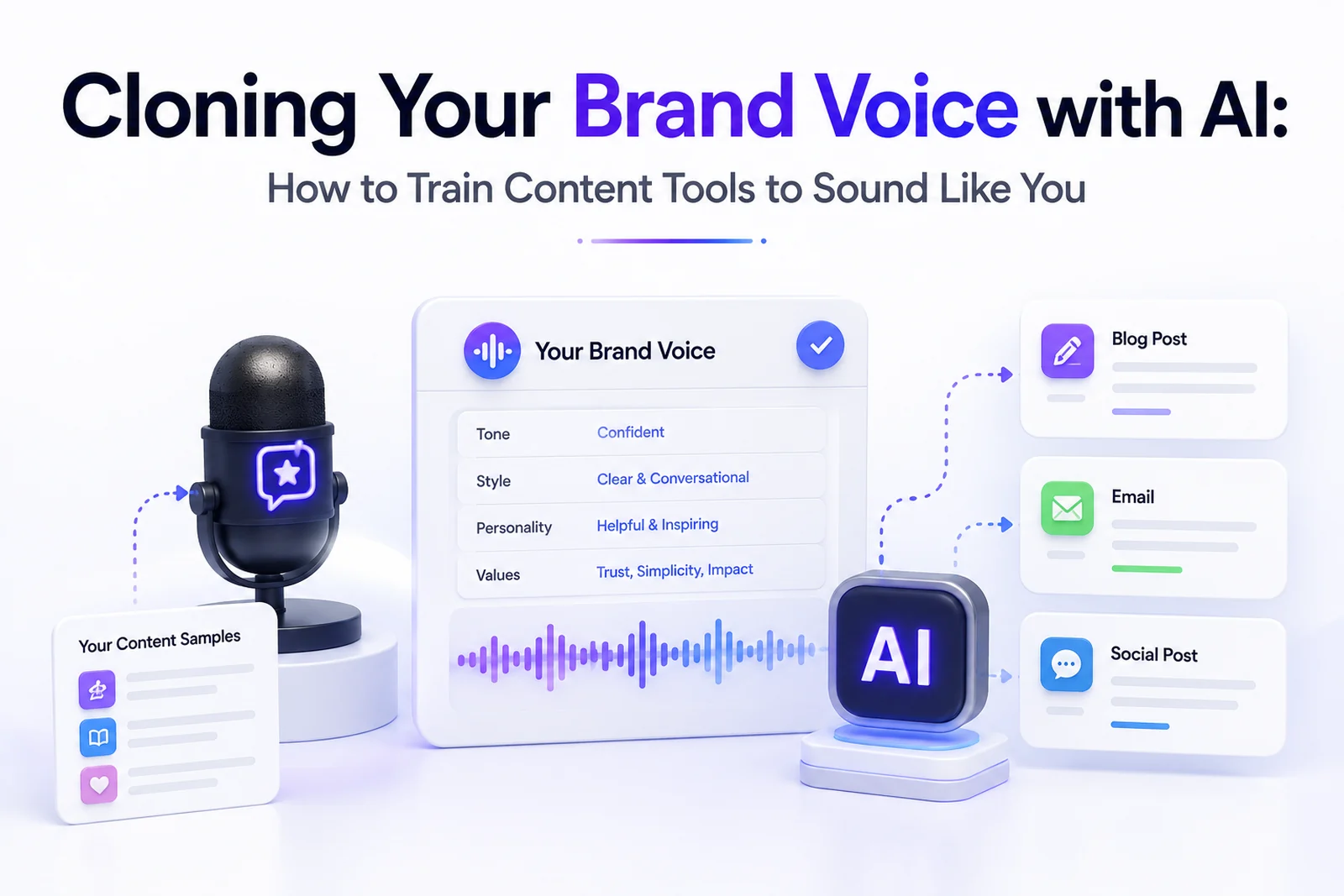
A new approach to AI content generation focuses on training tools using a brand's or individual's own past writing — meeting notes, previous articles, internal documents — so AI-generated output genuinely sounds like a specific voice rather than generic AI prose. For content marketing teams, this closes a long-standing gap. Here is how to implement it well.
Why Generic AI Voice Has Been a Persistent Problem
Default AI-generated content tends toward a recognisable, homogenised style — certain sentence structures, transition phrases and tonal patterns that readers increasingly identify as AI-written regardless of the underlying prompt. This generic voice undermines brand differentiation precisely when authentic, identifiable voice matters more for reader trust. Voice cloning through targeted training data is a direct response to this specific weakness.
How Voice Cloning Actually Works
The approach involves feeding an AI tool a substantial corpus of existing writing from the person or brand whose voice you want to replicate — blog posts, email newsletters, internal memos, transcribed talks — along with explicit style guidance about tone, sentence length preferences and characteristic phrases. The AI tool uses this corpus as a reference to shape new output, producing content that matches established patterns rather than defaulting to generic AI style.
Building Your Training Corpus
Start by collecting the strongest examples of the voice you want to replicate — pieces that genuinely represent how the person or brand communicates at its best, not just the most recent or most convenient content. Aim for volume and variety across formats, since a corpus limited to one content type will produce a narrower, less flexible voice model than one drawing from diverse writing contexts.
Practical Applications for Content Marketing
Voice cloning works particularly well for scaling founder or executive thought leadership, where a single person's authentic perspective needs to appear across many more channels and formats than they have time to write personally, and pairs naturally with a defined branding and design system so voice and visual identity stay aligned. It also helps brands maintain consistent tone across a growing content team, using the cloned voice model as a shared reference point rather than relying purely on style guide documentation that team members interpret differently.
Quality Control and the Limits of Voice Cloning
Even well-trained voice models require human review before publishing, both for factual accuracy and for catching the subtle moments where AI output drifts from the intended voice. Treat cloned-voice output as a strong first draft rather than a finished product, and still run it through the same SEO checks — structure, keywords, internal links — you would apply to any other page. The efficiency gain comes from reducing revision time, not from eliminating human oversight of the final content marketing output entirely.
Working With DigiVeritaz on Voice-Consistent Content
DigiVeritaz builds voice-consistent content programmes for Indian brands, combining AI-assisted drafting trained on existing brand voice with editorial oversight to maintain both authenticity and scale. Businesses looking for a digital marketing agency in India that understands how to responsibly deploy this technology should ask how prospective partners handle voice consistency across a growing content calendar. Book a free content strategy session to discuss your brand voice goals.
Frequently Asked Questions
How much writing sample do I need to clone a voice effectively?
More is generally better, but a solid starting corpus of 20 to 30 varied pieces of writing typically provides enough pattern data for a usable voice model.
Can I clone a brand voice that has multiple contributors?
Yes, though it works best when trained on the strongest, most representative examples of the intended unified brand voice rather than every contributor's individual style.
Does voice cloning eliminate the need for editors?
No. Human review remains essential for factual accuracy and catching moments where output drifts from the intended voice, even with a well-trained model.
Is this different from just giving AI a style guide?
Yes. Training on actual writing samples captures nuanced patterns — sentence rhythm, characteristic phrases — that a written style guide alone typically cannot fully convey.
Explore our content marketing services in India or contact us at +91 88509 34184.