
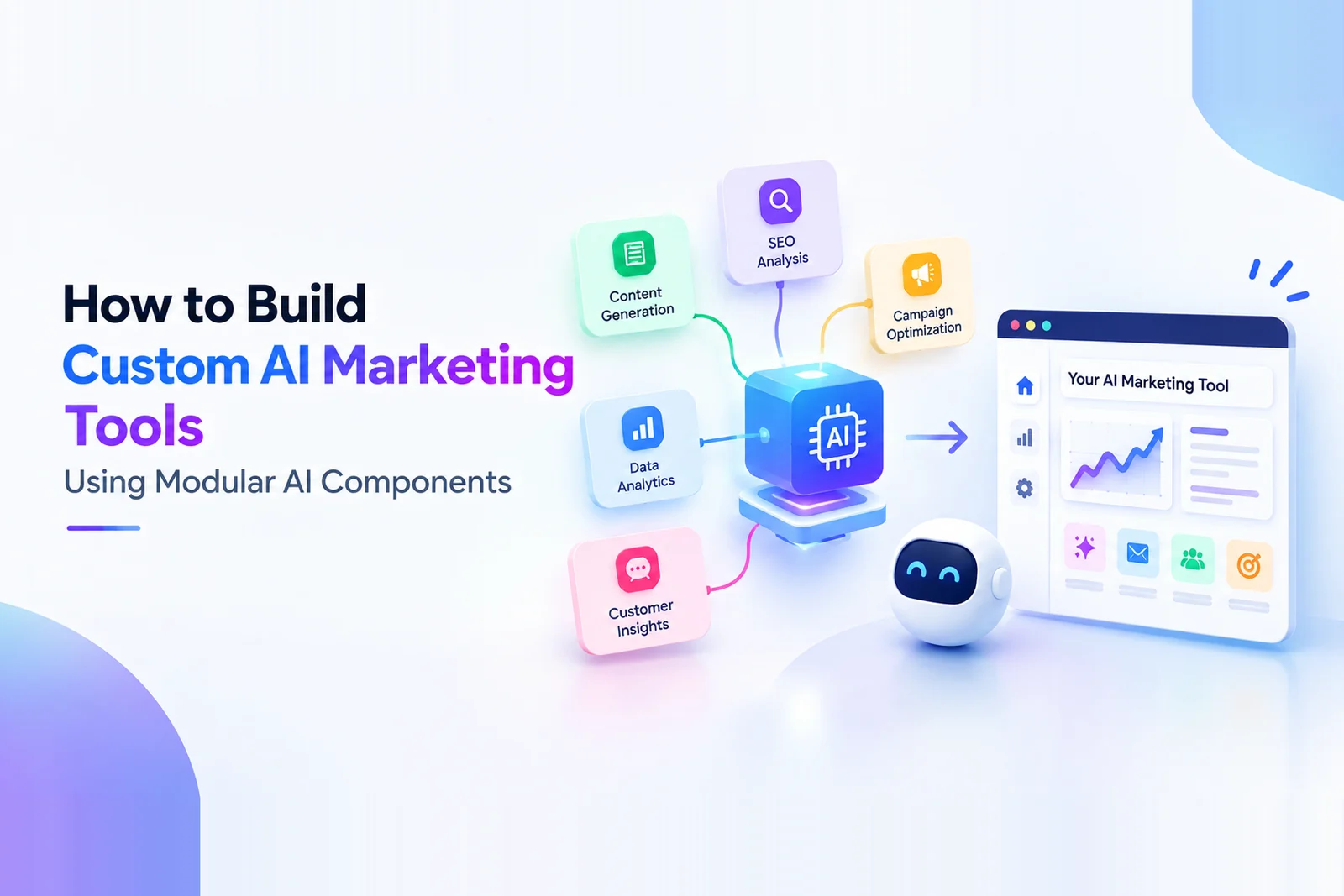
The next phase of AI in marketing is not just using existing tools — it is assembling your own. Businesses are now combining modular AI components — pre-built capabilities for natural language processing, image understanding, data retrieval and workflow automation — into custom marketing systems that fit their specific needs rather than adapting their workflows to off-the-shelf tools. Here is how Indian marketing teams can approach this practically.
What Modular AI Actually Means
Traditional software is built as a single, integrated product — you buy the whole tool or you do not. Modular AI works differently: individual capabilities — a language model for writing, a vision model for image analysis, a retrieval system for searching documents, a classification model for sorting data — are available as independent components through APIs. Businesses can combine these components into custom workflows specific to their needs, connecting them through orchestration tools like LangChain, CrewAI or simple Python scripts without building an AI model from scratch.
Why This Matters for Marketing Operations
Standard AI marketing tools are designed for the median use case. A modular approach lets you build exactly the tool your specific workflow needs — a brief-to-creative pipeline that uses your brand voice training data, a competitive monitoring tool that checks specific rival pages daily and summarises changes, a lead enrichment tool that researches inbound leads and writes personalised first-draft outreach. These are tasks where off-the-shelf tools provide 70 percent of what you need; modular assembly closes the remaining 30 percent. The result is AI that fits your process rather than a process that fits the AI.
Four Practical Modular AI Use Cases for Marketing Teams
First, a content approval pipeline that checks drafts against brand guidelines, SEO requirements and factual accuracy before sending to human review — combining a language model with a rules engine. Second, a social listening summariser that checks brand mentions across platforms daily and surfaces the most strategically relevant ones with context — combining a web retrieval tool with a language model. Third, a performance report narrator that takes raw campaign data and produces a plain-language weekly summary with recommendations — combining a data connector with a language model. Fourth, a competitor price and messaging tracker that monitors rival landing pages and alerts the team when key claims or offers change. Each of these can be built by a team member with basic Python skills or through no-code orchestration tools. Pairing these tools with a disciplined analytics configuration setup ensures the data feeding into them is clean enough to produce useful output.
What You Need to Get Started
Three things are needed before building your first modular AI tool. First, API access to at least one capable language model — OpenAI, Anthropic, Google or Alibaba's open-weight models all work. Second, a clear definition of the specific workflow you want to automate, written out step by step in plain language before any code is written. Third, a designated team member with either Python proficiency or comfort with no-code tools like Zapier, Make or n8n who will own the build and maintenance. The most common failure is starting without the second step — attempting to build a tool before the workflow it should automate is clearly defined.
Governance and Quality Control
Custom-built AI tools carry custom-built risks. A modular AI system that produces incorrect performance summaries or misroutes leads can cause real damage before anyone notices. Build human review checkpoints into any workflow that produces external-facing output. Log all AI actions and outputs so errors can be traced and the system can be improved. Set up automated tests that run against known good outputs weekly to catch regressions when underlying models update. And apply the same data strategy consulting governance principles to your modular AI tools that you would apply to any other system handling marketing data.
Working With DigiVeritaz on AI Marketing Tooling
DigiVeritaz designs and builds custom modular AI marketing workflows for Indian brands, combining the right components for each specific operational need with governance structures that keep the output reliable. Book a free AI workflow consultation to see which of your current manual marketing processes are the best candidates for modular AI automation.
Frequently Asked Questions
Do I need to know how to code to build modular AI marketing tools?
Basic Python knowledge or comfort with no-code orchestration tools like Zapier, Make or n8n is sufficient for most marketing automation use cases. The most complex modular builds require developer involvement, but many practical marketing tools can be built without advanced coding.
What is the difference between modular AI and using ChatGPT directly?
Using ChatGPT directly is a single-tool interaction. Modular AI involves connecting multiple capabilities — a language model, a data retrieval system, an automation layer — into a workflow that operates with less manual intervention and can draw on multiple data sources.
How much does it cost to build a modular AI marketing tool?
For simple tools built with existing API access, the main cost is development time. API costs for most marketing-scale modular tools are typically a few hundred to a few thousand rupees per month depending on usage volume.
What is the biggest risk with custom-built AI marketing tools?
Incorrect output reaching customers or decision-makers without human review. Always build human approval checkpoints into any AI workflow that produces external-facing content or consequential decisions until confidence in the tool's reliability is well established.
Explore our performance marketing services or contact us.