
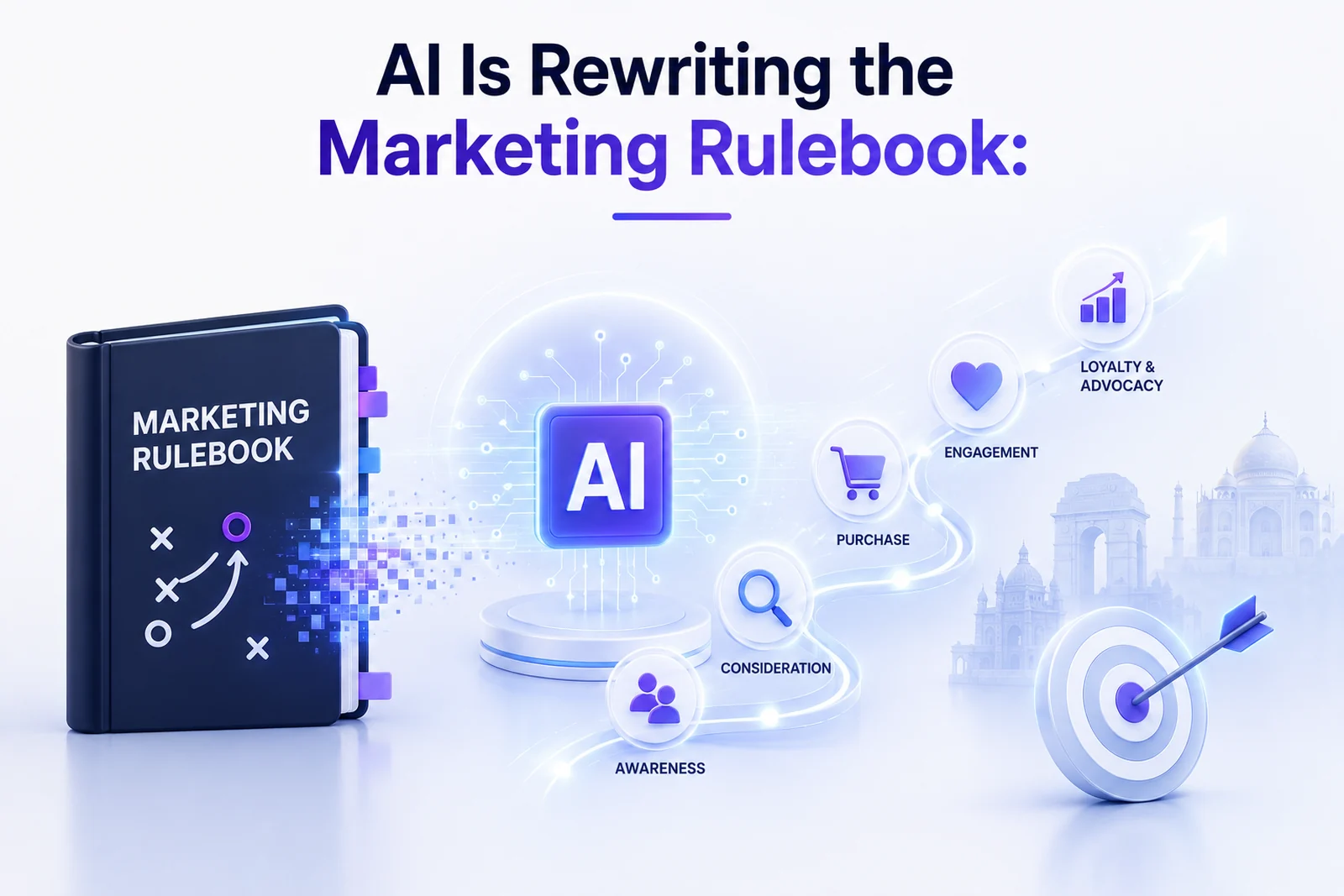
A new industry report confirms what many Indian marketing leaders are quietly observing: long-established marketing strategies are losing effectiveness as AI changes how customers find, evaluate and buy products. The traditional funnel, built around search clicks and sequential touchpoints, is fragmenting. Here is how to rebuild a customer journey that works in an AI-mediated world.
What the Report Says About Traditional Funnels
The report identifies three specific ways AI is breaking the traditional marketing funnel. First, AI assistants are now completing the discovery and comparison stages of the buyer journey on behalf of users, collapsing what used to be a multi-touchpoint process into a single AI interaction. Second, AI-driven ad personalisation has raised baseline expectations so dramatically that generic targeting now actively damages brand perception rather than simply underperforming. Third, AI is making purchase decisions less linear — buyers are jumping from awareness to consideration to purchase in compressed timeframes enabled by AI research tools, bypassing the slow nurture sequences traditional marketing relies on.
What a Rebuilt Customer Journey Looks Like
The rebuilt journey starts with AI presence rather than search ranking. The first brand impression a potential buyer receives often comes from what an AI assistant says about your category, not from a Google search result they click through. Building that AI presence — through content structure, digital PR and entity recognition — replaces top-of-funnel content marketing as the first priority. The middle of the funnel shifts from sequential email nurture to multi-channel accessibility: being present wherever the buyer is doing research, whether that is LinkedIn, YouTube, AI assistants or industry publications.
Rethinking Lead Nurture for AI-Accelerated Buyers
Buyers using AI research tools move faster through evaluation than the same buyer researching manually. A lead nurture sequence designed for a 45-day decision cycle will feel irrelevant to a buyer who has already compared five vendors in an AI assistant and narrowed to two. Audit your nurture sequences for pace mismatch — are you sending educational content to prospects who have already done the education through AI tools? Faster, more direct sequences that assume AI-literate buyers are now appropriate for a growing segment of your lead pool.
What Stays the Same
Several marketing fundamentals are unchanged by AI: trust, built through consistent delivery and genuine customer outcomes, remains the ultimate conversion driver. Human relationships in B2B sales cycles still close complex deals. Product and service quality still determines retention. Brand distinctiveness still earns margin premium. AI changes the discovery and evaluation channels, not the underlying decision criteria buyers ultimately use. Rebuilding the funnel means updating the channels and formats, not abandoning the principles.
Practical Steps to Start the Rebuild
Three immediate priorities for Indian brands: audit which stages of your current funnel assume pre-AI buyer behaviour, identify where AI-assisted buyers are entering your pipeline and what they already know when they arrive, and test compressed nurture sequences against existing ones for AI-literate audience segments. Combine this with a strong lead generation programme rebuilt around AI-era intent signals and supported by robust SEO foundations so you remain visible whether buyers arrive through search or AI assistants.
Working With DigiVeritaz on Funnel Rebuilding
DigiVeritaz helps Indian brands audit and rebuild their customer acquisition funnels for the AI-mediated buyer journey, combining performance marketing, content strategy and lead nurture redesign into a single programme. Book a free funnel audit to identify where your current journey is losing AI-era buyers and what a rebuilt approach would deliver.
Frequently Asked Questions
Is the traditional marketing funnel completely dead?
No. The stages of awareness, consideration and purchase still exist, but the channels through which buyers move through each stage are shifting. The funnel is not obsolete; the assumptions about how long each stage takes and which channels drive it are what need updating.
What does an AI-era top-of-funnel actually look like?
It increasingly starts with AI assistant mentions and recommendations rather than search click-throughs. Building AI presence — through content structure, digital PR and brand mentions in trusted sources — is the new top-of-funnel investment priority.
How much faster are AI-assisted buyers than traditional buyers?
Category and deal size dependent, but mid-market B2B buyers using AI research tools are reporting decision timelines 30 to 50 percent shorter than equivalent decisions made before AI research tools were available.
Does this affect B2C as much as B2B?
Yes, but differently. B2C buyers accelerate the consideration phase using AI product comparison and recommendation. B2B buyers accelerate the vendor research and shortlisting phase. Both require updated funnel assumptions and adjusted marketing pacing.
Explore our performance marketing services or contact us.