
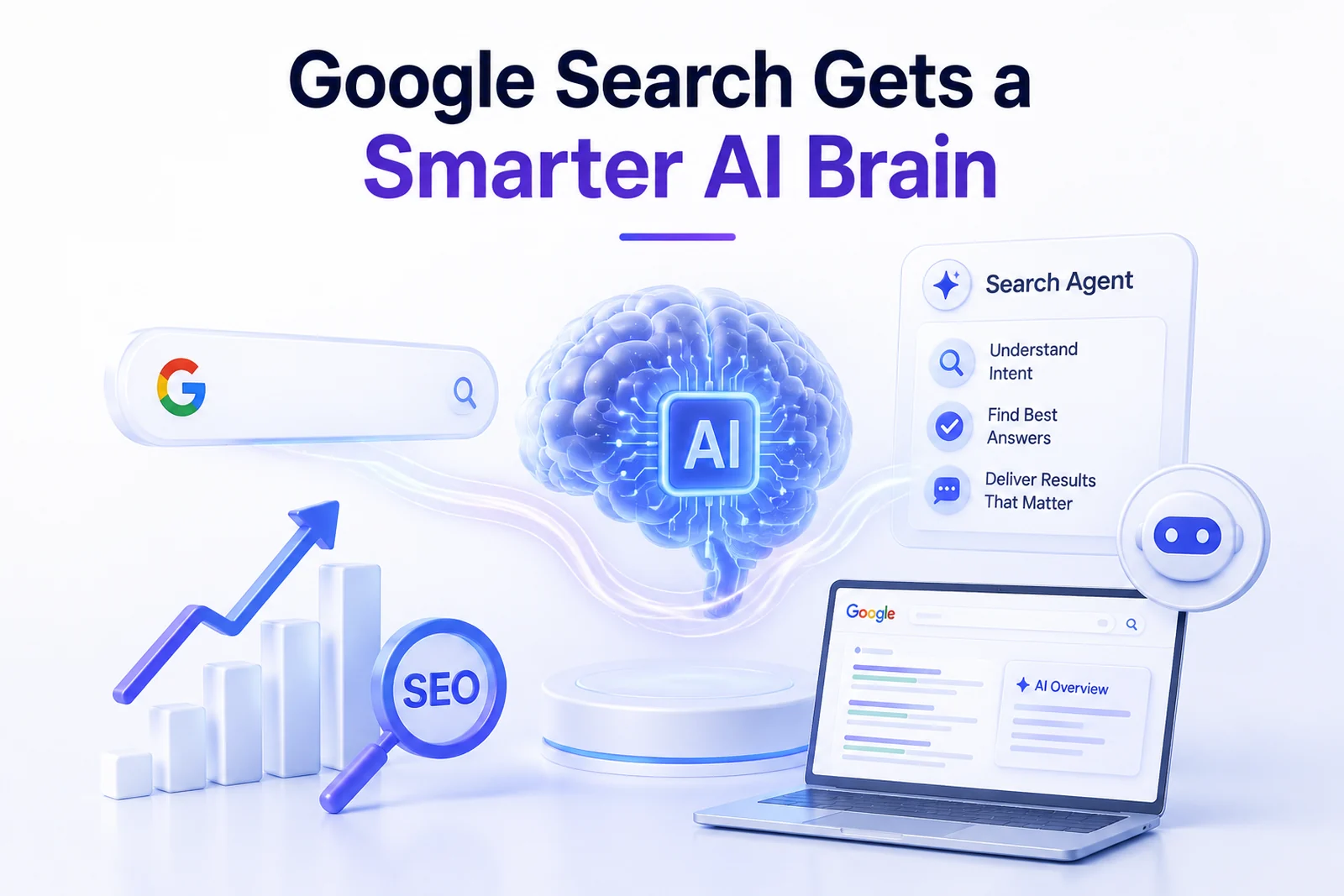
Google has added a new, significantly faster AI reasoning layer to its search engine, specifically designed to power Search Agents — AI assistants that can research across multiple sources and synthesise answers — and to improve the quality of AI Overviews. For brands already adapting to AI search, this is a significant acceleration of the same trend, not a new direction. Here is what it means for SEO in practice.
What Google's New AI Search Layer Does
The new AI reasoning model Google has integrated into Search is designed for multi-step research tasks — following chains of information across sources, synthesising multiple angles into a coherent answer and completing tasks that previously required the user to visit several different websites. Search Agents powered by this layer can book appointments, compare products across multiple retailers and compile research on a topic, all inside the Google interface. The implication is that complex research queries — historically the ones that drove the most valuable organic traffic — are increasingly handled by Google without requiring a click.
How Content Needs to Be Clearer Than Ever
The faster and smarter the AI search layer, the more rigorously it evaluates content quality in real time. Content that is vague, poorly structured or thin on specifics is bypassed faster than before. Content that directly and clearly answers well-defined questions in parseable, structured form gets cited more reliably. The premium on genuinely informative, clearly structured content increases as Google's AI gets better at distinguishing it from padded, keyword-stuffed copy.
What Search Agents Change About Buyer Behaviour
Search Agents executing multi-step research tasks on behalf of users change the buyer journey at the top and middle of the funnel. Users delegating research to a Search Agent are implicitly asking it to filter, compare and recommend — which means they arrive at your brand either pre-approved by the agent's analysis or not at all. Brands not appearing in the source material that agents draw from are invisible to this new research pathway. The brands that do appear in those sources arrive to a more informed, more pre-qualified visitor.
The Practical SEO Response
Three priorities follow from this shift. First, structured, factual content that an AI agent can parse and cite — definitions, comparisons, specific data and clearly organised how-to information. Second, schema markup that explicitly identifies the type of content on each page so agents can categorise and retrieve it correctly. Third, authoritative third-party mentions and editorial coverage that agents treat as validation signals, which returns us to the same digital PR priority that has emerged across every AI search development this year.
Connecting This to Your Broader Content Investment
The smarter Google's AI search becomes, the more the content fundamentals matter and the less surface-level SEO tricks work. Brands investing in depth, originality and genuine expertise in their content marketing accumulate compounding advantage as AI search gets better at distinguishing quality from volume. Brands investing in tactical optimisation with thin underlying content see declining returns. The trajectory is clear: quality content with strong editorial PR backing is the sustainable position in 2026 and beyond. Businesses seeking a digital marketing agency in India should treat this as the primary question to ask any prospective SEO partner.
Working With DigiVeritaz on AI-Ready SEO
DigiVeritaz builds content and SEO strategies for Indian brands designed for the AI search environment — combining structured content, schema implementation, editorial PR and technical foundations that perform as Google's AI layer gets faster and smarter. Book a free AI search readiness audit to see where your current content investment needs to shift.
Frequently Asked Questions
What are Google Search Agents?
Search Agents are AI-powered assistants within Google Search that can complete multi-step research tasks, compare options across sources and even take actions like booking appointments, all within the Google interface without requiring the user to visit external websites.
How do Search Agents change what content gets cited?
Agents need to pull from high-quality, clearly structured, factual sources to construct reliable answers. Content that is vague, poorly organised or thin on specifics is bypassed; content that directly answers well-defined questions with clear structure gets cited more.
How fast is Google's new AI reasoning model?
Google describes the new model as significantly faster than its previous search reasoning systems, designed specifically to power the real-time, multi-step processing that Search Agents require without introducing noticeable latency for users.
Do I need to do anything different for Search Agent optimisation?
The optimisation principles are consistent with broader AI search preparation: structured content, comprehensive schema markup, clear question-and-answer formatting and strong editorial backlink profile. No separate technical implementation is required.
Explore our SEO services or contact us.