
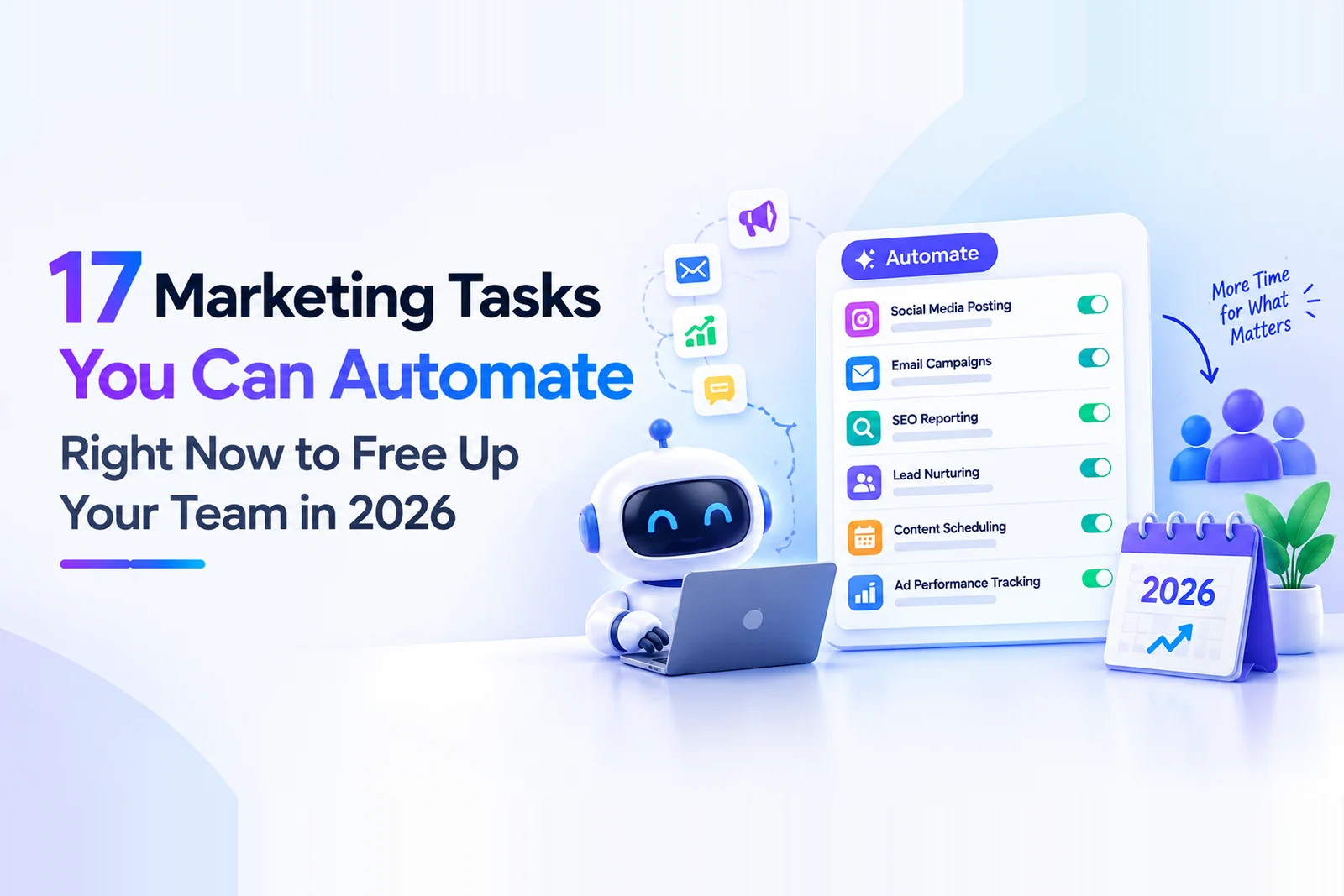
A new industry guide has catalogued 17 specific marketing tasks that can now be reliably automated using AI and workflow tools available in 2026. For Indian marketing teams that are perpetually short on time for strategic work, identifying which repetitive tasks to hand off to automation is one of the highest-leverage moves available. Here is the list, organised by the type of work and the tools that handle it best.
Reporting and Analytics Automation (Tasks 1 to 4)
Four reporting tasks are now reliably automatable. First, weekly campaign performance summaries: AI tools connected to Google Ads, Meta and GA4 can produce narrative performance reports without manual data compilation. Second, competitor content monitoring, where tools like Brandwatch or custom-built AI scrapers check rival websites and social channels daily and surface changes. Third, keyword ranking change alerts, meaning automated rank tracking with AI-written summaries of significant movements. Fourth, social media performance digests, where platforms like Buffer now auto-generate content performance summaries. Together, these four automations can save a mid-market Indian marketing team three to five hours per week. Pairing these tools with structured analytics configuration ensures the underlying data they summarise is accurate.
Content Production Automation (Tasks 5 to 9)
Five content production tasks have reached reliable automation maturity. Fifth, first-draft blog post generation from a detailed brief, where AI produces a structured draft that a human editor refines. Sixth, social media caption adaptation, where AI rewrites approved content into platform-specific caption formats without tone drift. Seventh, email subject line variant generation, producing multiple subject line tests from a single content brief. Eighth, image alt text generation for website images, where AI reads image content and produces SEO-appropriate alt text at scale. Ninth, FAQ generation from existing service page content, where AI identifies likely questions and drafts answers in brand voice. These five, applied consistently, compress content marketing production timelines significantly without reducing human editorial control over final output.
Lead Management Automation (Tasks 10 to 13)
Four lead management tasks can now be automated reliably. Tenth, lead qualification scoring, where AI classifies inbound leads by firmographic and behavioural signals before human review. Eleventh, CRM data enrichment, where AI researches inbound leads and adds company size, industry and relevant context to CRM records automatically. Twelfth, first-draft personalised outreach, where AI generates initial outreach emails from lead enrichment data for human review before sending. Thirteenth, follow-up sequence triggering, where automation tools send the right follow-up message based on specific lead behaviour, such as opened but did not reply, or clicked but did not book, without manual monitoring. Each of these directly accelerates lead generation pipeline velocity.
Customer Communication and Support Automation (Tasks 14 to 17)
Four customer-facing tasks are automatable without sacrificing quality when implemented with appropriate human oversight. Fourteenth, FAQ chatbot responses on website and WhatsApp, where AI handles common queries around the clock and escalates complex ones to human agents. Fifteenth, review response drafting, where AI generates professional response drafts to new reviews across platforms for human approval before posting. Sixteenth, onboarding email sequences, delivering the right information at the right stage of a new customer relationship. Seventeenth, meeting preparation summaries, where AI reads the prior conversation history and briefing documents and produces a preparation summary before scheduled calls. Each of these supports customer experience consistency at scale without proportional staffing increases.
How to Prioritise Which Tasks to Automate First
Not all 17 are worth automating simultaneously. Prioritise by three criteria: how much time the task currently consumes per week, how reliably AI handles it without human correction (simpler, more structured tasks score higher), and how significant the error cost is if the automation produces incorrect output, since customer-facing tasks with high error cost should have human review checkpoints. Start with reporting automation and internal content production tasks, which have high time savings, lower error risk and clear quality signals that make it obvious when automation fails. Build confidence with these before moving to customer-facing automation that requires stronger governance. Teams ready to go further can assemble their own tools from modular AI components rather than buying off-the-shelf.
Working With DigiVeritaz on Marketing Automation
DigiVeritaz implements marketing automation programmes for Indian brands, identifying the specific tasks where automation will deliver the highest returns for each team's workflow and building the integrations, governance and quality checks that make automation reliable rather than just fast. Book a free automation audit to see which of these 17 tasks your team is still doing manually and what it would take to offload them.
Frequently Asked Questions
Which of the 17 automation tasks delivers the fastest ROI?
Weekly campaign performance report automation typically delivers the fastest and most measurable time saving, replacing two to three hours of manual data compilation with an automated summary that a human reviews and sends.
Does automating content production mean lower quality?
Not if implemented correctly. AI-assisted first drafts with mandatory human editing produce content faster without reducing quality, because the human review step maintains editorial standards. AI-only content without human review does tend to be lower quality.
What tools do I need to automate these 17 tasks?
Most can be accomplished with a combination of AI access (ChatGPT, Claude or similar), an automation platform (Zapier or Make), a scheduling tool and your existing marketing platforms. No single tool covers all 17.
How do I prevent automation from producing incorrect outputs?
Build human review checkpoints into every automation workflow that produces external-facing output. Log all automated actions. Set up weekly quality checks that compare automated outputs against known-good examples.
Explore our performance marketing services or contact us.