
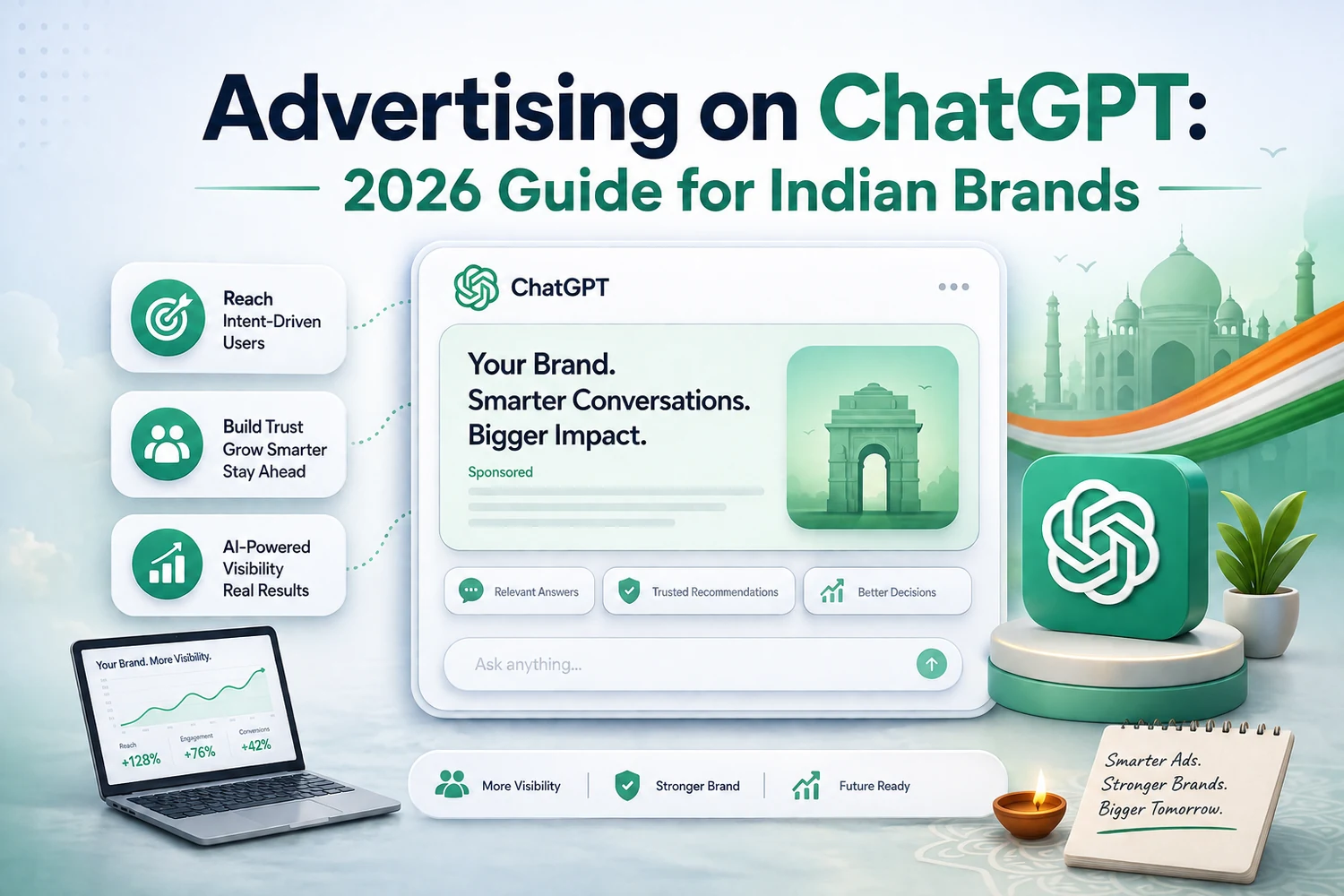
OpenAI has launched an official advertising platform inside ChatGPT, opening a new paid channel that reaches hundreds of millions of active users worldwide. For Indian brands, this is the first material addition to the paid media landscape in years. Here is what ChatGPT advertising actually is, how it works and how to evaluate whether it belongs in your 2026 media mix.
What ChatGPT Advertising Looks Like
ChatGPT ads appear as sponsored responses positioned below the AI-generated answer to a user query. They are targeted primarily by conversation context — the topic the user is discussing — and secondarily by user attributes where consented. Unlike traditional search ads, ChatGPT ads do not compete on keyword bids in the classic sense; they compete on relevance to the conversation and advertiser-defined intent signals. Format-wise, they are compact, text-first units with optional imagery, designed to blend into the conversational interface rather than interrupt it.
Why It Matters for Indian Advertisers
ChatGPT usage among Indian professionals, students and small business owners has grown fast, and a meaningful share of commercial research now happens inside the assistant rather than on Google. For categories where buyers ask evaluative questions — comparing products, researching services, planning purchases — ChatGPT ads intercept intent earlier in the funnel than search ads do. Cost per impression is currently competitive because inventory outstrips advertiser demand in most Indian categories. Early movers who build audience data and creative learnings now will have a compounding advantage as the auction gets more competitive over the next 12 months.
Setting Up Your First ChatGPT Campaign
Start with three campaign structures rather than one. A conversation-intent campaign targeting queries related to your category. A branded-defence campaign making sure your brand shows up when users ask about you specifically. And a competitor-comparison campaign appearing on queries where users are comparing options in your space. Budget allocation should heavily favour conversation-intent in the first 60 days because that is where new demand lives; the other two campaigns are protective plays. Track cost per conversation-driven site visit rather than raw click volume, because ChatGPT users click less often but convert at higher rates when they do.
Creative Best Practices for AI-Native Ad Placements
Creative that reads like an answer outperforms creative that reads like an ad. Lead with a clear, specific value proposition tied to the conversation topic. Use short, natural sentences rather than marketing headlines. Include one concrete data point — a price range, a duration, a success rate — that gives the user something tangible to click for. Avoid urgency stacking and hard-sell CTAs; the ChatGPT audience responds poorly to interruption tactics. Test three variants per campaign minimum, and let the platform's optimisation choose winners over the first two weeks before pulling manual levers.
Measuring ROI and What to Compare Against
The right benchmark for ChatGPT ads is not Google Search — it is the top-of-funnel and mid-funnel channels you currently use for research-stage buyers. Compare cost per qualified lead against LinkedIn ads for B2B categories, against display and native for consumer categories, and against branded search for defensive campaigns. Attribution is imperfect because ChatGPT users often complete their journey days later on a different device, so account for view-through and assisted conversions in your measurement model. For most Indian mid-market brands, a 90-day test with a defined budget cap is the right way to evaluate whether ChatGPT ads earn a permanent slot in the media mix. Combining paid ChatGPT campaigns with a strong SEO foundation and generative engine optimisation compounds results faster than either channel alone.
Working With DigiVeritaz
DigiVeritaz has been running ChatGPT advertising campaigns for Indian brands since the platform launched. Our approach combines conversation-intent research, competitive positioning, structured creative testing and cross-channel attribution to make ChatGPT ads a measurable pipeline contributor rather than an experimental line item. Book a free ChatGPT ads audit to see whether the channel fits your category and what a 90-day test would produce.
Frequently Asked Questions
How much do ChatGPT ads cost?
Cost per impression and cost per click on ChatGPT ads are currently competitive with LinkedIn ads for B2B categories and with display and native for consumer categories. Auction density is still low, so early movers pay less than they will in 12 months.
What kinds of businesses should try ChatGPT ads?
Businesses whose buyers do meaningful research before purchasing — B2B services, education, financial services, real estate, healthcare, considered consumer purchases — benefit most because ChatGPT intercepts research-stage intent that Google Search increasingly does not.
How do I measure ChatGPT ad performance?
Track cost per qualified lead against your other research-stage channels. Attribution is imperfect because ChatGPT users often complete their journey days later on a different device, so account for view-through and assisted conversions in your measurement.
What budget should I start with?
A 90-day test at a defined budget cap — typically INR 2 to 5 lakh — is the right scale to evaluate whether ChatGPT ads earn a permanent slot in your media mix without overcommitting before you have learnings.
Explore our performance marketing services or contact us.